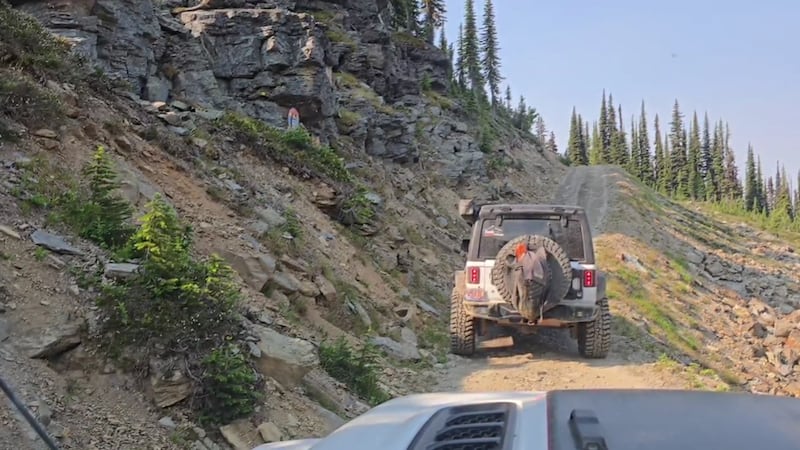
A remote road near Trout Lake could soon be physically deactivated, prompting recreation groups to ask whether B.C. should remove an established backcountry route before fully examining other options. The Rady Creek Forest Service Road has been posted for deactivation as early as August 2026, according to the B.C. government, which says planning is underway. The road provides access toward Silver Cup Ridge, an area used by snowmobilers, four-wheel-drive enthusiasts and other backcountry recreationists, as well as people with mineral claims in the area. Now, several organizations are asking the province to pause the work and consider whether parts of the route could instead be stabilized and managed for recreation. The call for a pause is backed by seven organizations, including the B.C. Snowmobile Federation, Four Wheel Drive Association of B.C., Trout Lake Recreational Club and Quad Riders ATV Association of B.C. “We’re not looking for every forest service road to remain open,” said Amber Lane, executive director of the British Columbia Snowmobile Federation. “What we are looking for is, once something has been established as valuable by the recreation community, why can’t we halt deactivation and identify and overcome this policy gap?” A road with a long history Lane says Rady Creek is different from a typical industrial road that has reached the end of its working life. The route dates back more than a century to the mining activity that helped shape Trout Lake, she said. Today, she argues, it has become part of the community’s recreation and tourism infrastructure. “You have to remember that the people of Trout Lake, they don’t have a pool, they don’t have a library. They have trails,” Lane said. “That community was originally a mining community and now focuses on summer and winter tourism. Without access to recreation, that community is slowly going to cease to exist.” In a statement, the province said it recognizes that forest service roads are important to people living in rural and remote areas and prioritizes roads needed for safe and reliable access to communities, recreation and tourism. The province said it notifies local tenure holders, stakeholders and known road users before deactivation to explore alternative maintenance arrangements. It said an application has been submitted to maintain a trail over the Rady Creek Forest Service Road and that a formal decision is expected in autumn 2026. That timing is a key concern for advocates, who want the application and any future management arrangement considered before irreversible physical work takes place. Questions over the technical evidence The province has cited slope stability and environmental concerns in planning the deactivation, with full road-prism pullback required in some sections. That work can involve reshaping or removing the constructed roadbed and restoring drainage, potentially making vehicle access impractical or impossible. Lane says recreation organizations have asked for the technical information behind the decision but have not received it. “We have not received those geotechnical reports, so we have not been able to independently review them in any way,” she said. She argues the engineering question also needs to account for how the corridor would be used in the future. The province’s assessment of an industrial road, she said, may involve standards intended for logging trucks and heavy equipment, while recreation users would generally be travelling in much lighter vehicles. “We would have to review all of that and put it past a geotech of our own or in conjunction with the province,” Lane said. The groups are not arguing that legitimate hazards should be ignored. They want the government to identify which portions require major work and whether targeted stabilization, seasonal access or another management model could address those risks without eliminating the established corridor. Search-and-rescue concerns For Colin T. Stuart of the Four Wheel Drive Association of B.C., the debate is informed by his experience helping activate search and rescue after the Aug. 7, 2025, accident near Silver Cup Ridge that killed adventure creators Matthew Yeomans and Stacey Tourout. His concern is what losing the vehicle-accessible route could mean during a future emergency. “Rady Creek is the central route in that whole area for their recreation trail,” Stuart said. “By removing that one route, it makes the whole area extremely more remote and it could potentially add hours on a response time.” He also worries that users could turn to alternative winter routes with greater avalanche exposure. The groups also want the province to consider whether the corridor could have value for emergency or wildfire access before it is permanently altered. “I would like them to assess to see if Rady Creek can become a fire access road in the case of a forest fire,” Stuart said. A bigger provincial question For Lane, the debate is ultimately about what happens when industrial infrastructure takes on a second life. B.C.’s Outdoor Recreation Strategy recognizes that recreation has developed alongside traditional industries such as forestry and mining, she said. Lane sees Rady Creek as an opportunity to determine what happens when an old industrial corridor becomes important to a community’s recreational life. “This road specifically is a test case for that strategy,” Lane said. “We figure out what is the policy, what does the transition look like.” The province’s current position is that roads must be assessed based on their ongoing need and safety, while alternative maintenance arrangements can be explored before deactivation. Who would maintain it? The recreation groups say they are not simply asking taxpayers to take on an indefinite maintenance bill. Lane points to existing recreation sites and Trails B.C. partnerships and user-supported models as potential examples. She also cited the province’s Off-Road Vehicle Fund, which supports motorized recreation infrastructure. The Four Wheel Drive Association of B.C., meanwhile, says its members already contribute to maintaining recreation sites in partnership with the province. “We have members that are paying yearly for us to advocate and maintain roadways,” Stuart said. The groups say a formal stewardship or partnership model could give the corridor defined responsibilities, rather than leaving the province with sole responsibility for maintaining an industrial-standard road. The decision ahead The province says the application to maintain a trail over the Rady Creek Forest Service Road is under review, with a decision expected in the fall. For Lane, the immediate priority is stopping physical deactivation long enough for that process to have meaning. “Since deactivation is slated for August 2026, we are running out of time,” she said. “I would like to see a commitment from the ministry of Forests to meet with the minister of Parks and Environment to figure out what this policy gap is and what this looks like going forward.” At Rady Creek, the immediate question is whether the existing corridor can be made safe and managed for recreation without compromising the environmental and geotechnical concerns identified by the province. The larger question is whether B.C. has a workable process for deciding when an industrial road has become too valuable to a community to simply disappear.