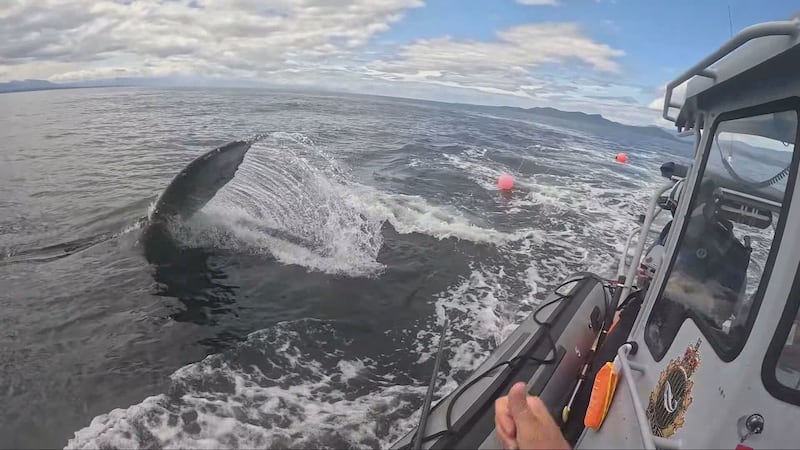
Two humpback whales are swimming free after Fisheries and Oceans Canada responders completed two separate disentanglement operations in a single day off Vancouver Island. The back-to-back rescues required quick co-ordination, careful planning and support from partners across the B.C. Marine Mammal Response Network as crews worked through challenging conditions to remove potentially life-threatening fishing gear. “It was crazy, but we’re still super euphoric from doing two in one day,” said Paul Cottrell with Fisheries and Oceans Canada’s marine mammal response program. The first rescue began after a report of an entangled humpback whale in the northern Salish Sea. Despite difficult weather, responders worked with Kwiakah First Nation to attach a satellite tag to the trailing gear, allowing them to track the whale and plan a safe approach. The whale later travelled south toward the area between Lasqueti Island and French Creek, where responders spent several hours carefully removing rope wrapped around its tail stock and fluke. The team used drone footage to assess the entanglement before approaching the animal. After putting a working line on the whale, responders were able to make a cut and remove the gear. As the first operation was coming to an end, another report came in about an entangled humpback whale in Port Alberni Inlet. With the equipment and crew already in place, responders travelled across Vancouver Island to begin a second rescue effort in Barkley Sound. The second whale was found with fishing gear wrapped around its tail area and fluke, causing visible injuries. The removal was a difficult operation, but responders were able to free the whale and begin monitoring its condition. Cottrell said the injuries suffered by the second whale show how quickly an entanglement can affect an animal. “We will be monitoring the second whale that has some injuries from the entanglement,” he said. “We’re hoping that it’s able to make it and thrive.” Both whales were humpbacks, a species that has become increasingly common in B.C.’s coastal waters. Cottrell said the growing number of whales in areas where fishing gear is present has also led to more reported entanglements. “We’re seeing a lot more humpbacks in inshore waters, but we’re also seeing, with that large number of humpbacks, overlap with fishing gear,” he said. The source of the gear removed from the first whale could not be identified. The buoy was unmarked and the trap attached to it had broken away. The second set of gear carried a tag indicating it came from the Washington state commercial crab fishery. Canadian and U.S. officials are now working together to determine where and when it was set, information that could help reduce future entanglements. The first whale was later identified by researchers as Wiggins, a humpback that responders had previously disentangled in the same area last September. During that rescue, more than 450 feet of gear was removed. This time, responders removed more than 250 feet of gear and floats from the whale. Researchers are continuing efforts to identify the second whale through photo catalogues that track individual humpbacks. Cottrell said the success of these rescues depends heavily on reports from people who are on the water, including whale watchers, commercial and recreational fishers, boat operators and coastal communities. “The public is really our eyes and ears,” he said. He says the quick reports received during these incidents gave responders the opportunity to locate the whales and intervene before the entanglements caused further harm. Anyone who sees a distressed or entangled marine mammal is asked to keep a safe distance, avoid attempting to remove any gear and report it immediately to the Marine Mammal Incident Hotline at 1-800-465-4336. Entangled whales can be unpredictable and dangerous. Trained responders have the equipment and expertise needed to safely remove fishing gear. “These whales do not recognize that we’re helping them in most cases,” Cottrell said. “It’s a lot of work. It’s a lot of patience.” For responders, the goal is simple: remove the threat, give the whale a chance to recover and prevent future entanglements whenever possible.