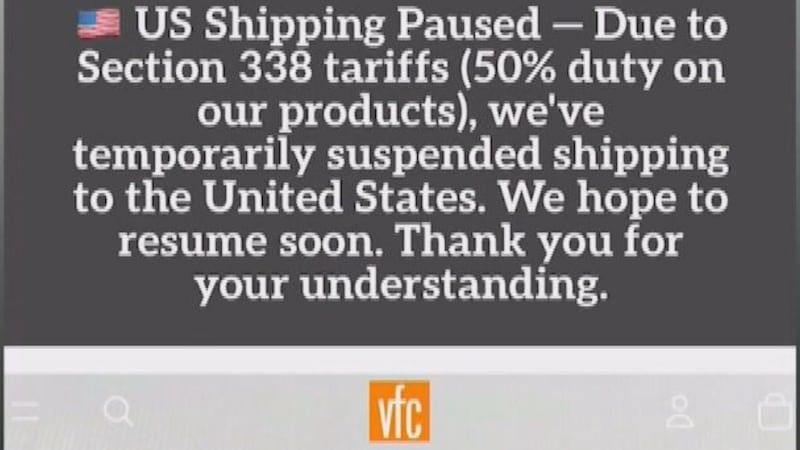
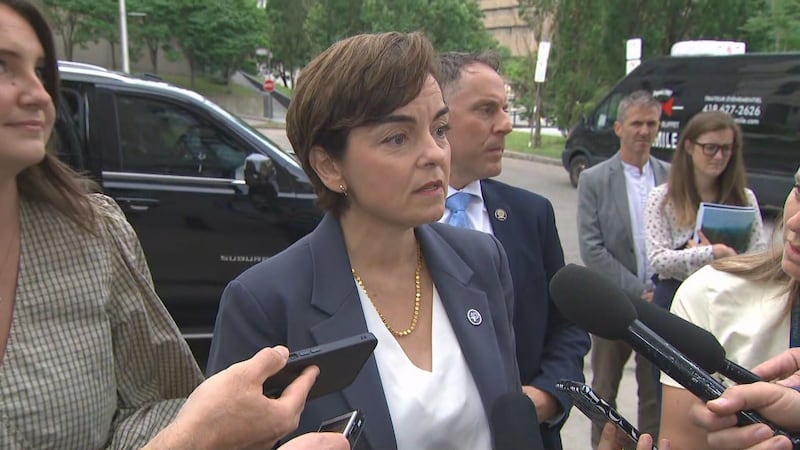
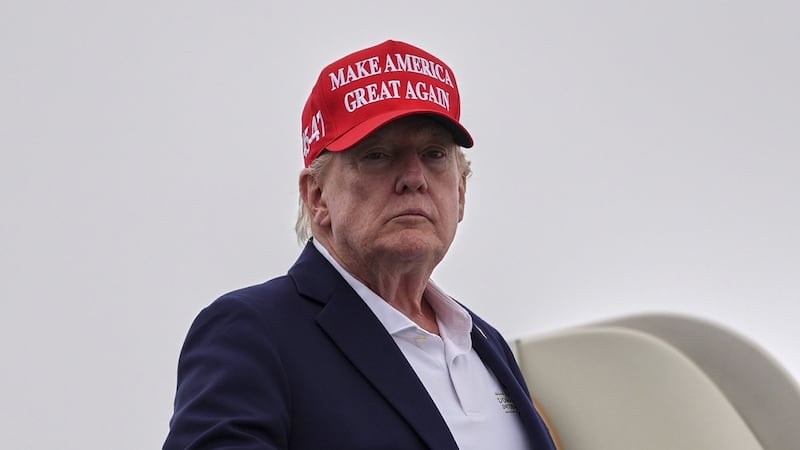
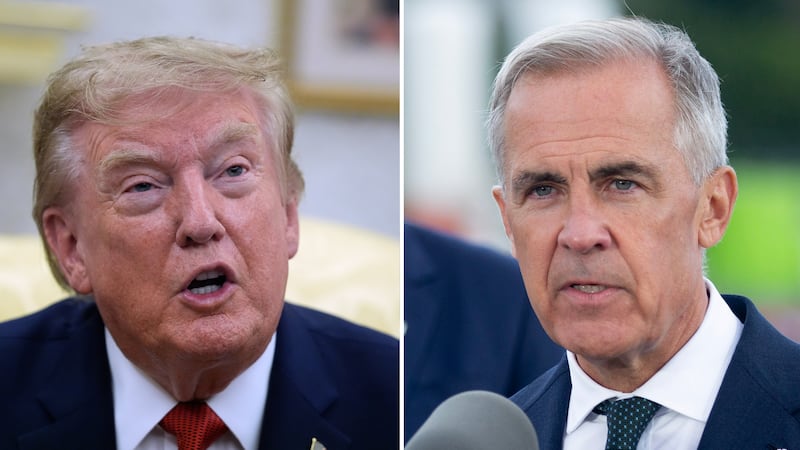
U.S. President Donald Trump has delayed his new 50 per cent tariffs on Canadian goods after he said the two countries reached a tentative deal and that the Keystone XL pipeline “may be awoken from the grave.” Prime Minister Mark Carney released his own statement that does not mention a deal, nor a pipeline. Though, he said, “substantial progress has been made.” Trump’s 50 per cent tariffs have been delayed by three days. Follow for key updates: Read Trump’s statement Trump posted the following message on his Truth Social platform late Tuesday evening. “I have paused the 50% Tariffs against Canada, that were scheduled to kick in tomorrow morning for a three day period, based on the fact that Canada and the U.S.A., subject to the finalization of documents, have a DEAL! The great Keystone XL Pipeline, long ago killed by Sleepy Joe Biden, may be awoken from the grave! Thank you for your attention to this matter. President DONALD J. TRUMP.” He then published an AI-generated image of himself hoisting the Keystone XL out of a gravesite marked by a tombstone labelled “BURIED BY BIDEN.” Read Carney’s statement Carney posted this message online on Tuesday. “Over the last number of weeks, Canada has engaged in intensive discussions with the United States to address outstanding trade issues and deliver greater certainty and real benefits for Canadian businesses, workers, farmers, and families. “Substantial progress has been made, although there is important work still to be done. As this work is ongoing, the United States has agreed to postpone the implementation of its 50% tariff on a range of Canadian goods under Section 338 of the U.S. Tariff Act of 1930 until end of day, August 21. “While we continue this work, Canada remains focused on building a stronger, more independent, and more competitive economy at home.” Trade talks today Canada-U.S. Trade Minister Dominic LeBlanc and Chief Negotiator Janice Charrette will meet U.S. Trade Representative Jamieson Greer at his office at 11:15 ET. Greer’s office posted on X last night congratulating Trump and giving some insight on a tentative trade agreement. “The deal will include comprehensive market access for all American goods, economic security commitments, digital trade alignment, and many important provisions that will continue to protect our market and American workers, along with our Canadian partners,” reads the post. Luca Caruso-Moro, CTVNews.ca journalist Quebec’s ‘red line’ Quebec Premier Christine Frechette passed CTV News cameras on her way into the legislature. She said she has not seen all the terms of Canada’s agreement with the U.S. to provide a statement on trade. But she reiterated her “red line, not to be crossed:” Supply management on dairy and “the protection of culture and language.” She added, “what businesses need is confidence and stability and stability and predictability.” Luca Caruso-Moro, CTVNews.ca journalist ‘Shooting themselves in the foot’ For the auto industry, the president of the Automotive Parts Manufacturers’ Association says any negotiated tariff rate must be below the profit margin. Flavio Volpe told CTV News, “It’s got to be below six per cent, and for 60 years we’ve been working at zero per cent.” Volpe, a member of the federal government’s group of insider advisers said if automakers are forced to absorb or pass on hundreds of millions of dollars in extra costs to consumers each year, plants in places such as Brampton or Woodstock, Ont., could move to the U.S. or elsewhere where they may be more profitable. “They [the United States] are just shooting themselves in the foot if they’re going to charge their own companies a penalty to sell to their own customers.” Ted Ballantyne, CTV News senior multiplatform writer Why is Trump talking about Keystone XL? When Trump announced on Tuesday night that he’d be postponing the tariffs for a few days, he hinted at the revival of a long controversial project to expand a cross-border oil pipeline from Canada into the U.S. First proposed in 2008, the Keystone XL pipeline has seen a rocky journey piled with legal barriers, opposition from environmental and Indigenous activists, and subject to the whims of U.S presidents at different points in time. Trump had revived the project during his first term but Biden shut it down on his first day as president. The pipeline came up in discussions last year when Carney pitched the pipeline in exchange for relief from U.S. tariffs on Canadian steel and aluminum. Devika Desai, CTVNews.ca journalist. Read the full story here. Businesses ‘negotiating for a little bit of stability’ The Trump administration has been successful at conditioning and changing expectations for Canadian businesses, Laura Dawson, executive director of the Future Borders Coalition told BNN Bloomberg. She believes, at this point, Canada is not trying to negotiate a permanent deal. “They’re negotiating for a little bit of stability to take them through a short period of time,” says Dawson, who advocates for Canada–U.S. cross-border business relations. Dawson stresses that businesses represent the microeconomy, and not the macroeconomy. So while CUSMA may affect a fraction of Canada’s GDP, it affects 100 per cent of some businesses. “So they are not being cavalier. They’re saying, ‘what do we need to do to survive for the next couple of months, and then build strength over the next couple of years?’” says Dawson, adding that businesses are celebrating the three-day reprieve after the U.S. President Donald Trump said he would pause sweeping 50 per cent tariffs on Canadian imports. “We had all the signs that it could happen. We had serious conversations taking place between the principal government negotiators on both sides. We had serious conversations taking place between governments and the respective business communities on both sides,” says Dawson. She says what happens next remains uncertain, but it’s clear that the U.S. is trying to reconfigure the shape of global trade because “it feels like it’s got a raw deal.” “It doesn’t want the kind of access and market power that China has had, and it said to the rest of the world, ‘We’re changing the rules, and you’re either with us or without us.’ And this was a hard lump for Canada to swallow,” says Dawson. Anam Khan, BNN Bloomberg journalist 13M jobs at risk: U.S. business group The imposition of higher U.S. tariffs would put 13 million American jobs at risk, according to U.S. Chamber of Commerce’s senior vice president, Neil Herrington. That’s the number of U.S. jobs that “depend on trade” under the Canada-U.S.-Mexico Agreement (CUSMA), according to Herrington. “The introduction of higher tariffs would damage both economies, drive up costs for U.S. families,” and “further disrupt critical supply chains,” he wrote in a Tuesday statement. Luca Caruso-Moro, CTVNews.ca journalist Relief in ‘limbo state’ Candace Laing, president and CEO of the Canadian Chamber of Commerce, said in a statement Tuesday that the tariff delay provides some relief on both sides of the border. She said an extension doesn’t bring the certainty of a signed interim deal. “This limbo state is not anyone’s preferred outcome — time is of the essence,” Laing said. “We commend the negotiating team for their work and sense of urgency this week, and call on them to keep it up: ultimately, a resilient and integrated North American economy would be a stronger one for all.” The Canadian Press