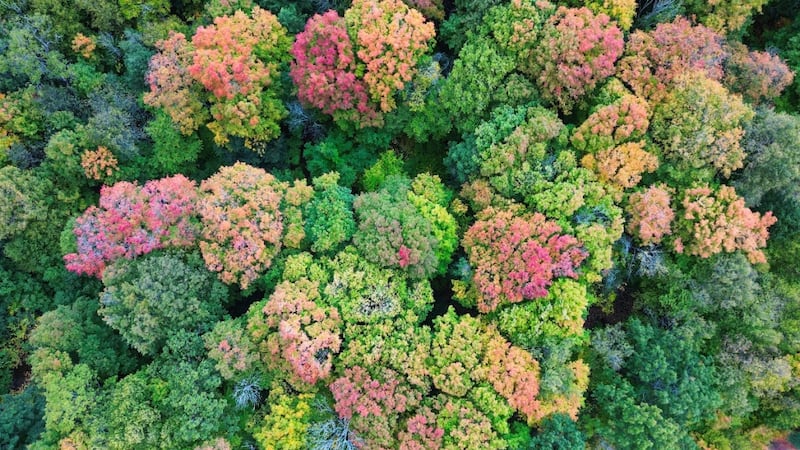
With the first official day of fall upon us, here’s what our region can expect as the weather begins to cool and we swap out our bathing suits for cozy knits. David Phillips, Climatologist with Environment and Climate Change Canada, says while some people say us Canadians go from sweat to slush, this year, it won’t be so – we will have a fall. What will fall be like? Phillips calls this fall a “legitimate season.” It won’t be two weeks of fall weather that we’ve seen in the past but rather, three months of it, he predicts. While you can feel it in the air, this year’s long-term autumn forecast is showing a warmer than normal season, with the first frost in Barrie not expected to make an arrival until October. Phillips says some of the factors contributing to that fall feeling have been the 4.9-degree-Celsius temperature we experienced in Barrie on Tuesday morning, the single-digit values over the last few days and losing almost 20 minutes of sunlight every day. The region is seeing a dryer September than normal, according to Phillips. We can also expect a cloud- and rain-free week with temperatures mostly typical for this time of year, which is around a high of 18 C and a low of 7 C. The shoulder seasons tend to save residents money. “You don’t have to have your air conditioning or heat on,” Phillips tells CTV News. “It’s a free energy time.” Colour changes Phillips says leaves are slow to change colour as the summer was so wet. But when they do, it’ll be a show. “They’re ready to take off with a technicolour vibrancy that will thrill us all,” Phillips says. “Colour change season is our reward for living here.” He predicts we’ll begin to see the colours change in Barrie after Thanksgiving but before Remembrance Day, making for a spectacular October. What about El Niño? As we make our way through fall with warmer than normal weather, that will also be the case for winter, thanks to a weather system called El Niño. El Niño is a weather phenomenon that happens when ocean water in the central and eastern Pacific Ocean is warmer than usual. As a result, it can affect weather around the world. It happens every two to seven years, alternating with a cooler weather pattern - La Niña. The one that we’re about to see though will affect us significantly in our region. “It’s the Godzilla of El Niño we’ve never seen,” Phillips says. “This one could potentially be the strongest one we’ve seen in a thousand years.” According to Phillips, the water in the Pacific has never been warmer and is currently about four degrees warmer than normal and that affects the jet stream and where the weather comes from. This will make for a more short-lived winter that’s not as cold as usual without as much snow as usual. He says the El Niño will die off in February and March. The good news is people will save on home heating bills and have easier commutes this winter, but the warmer, less snowy conditions will pose challenges for people who embrace the season and take part in activities like ice fishing, snowmobiling and skiing. “We’re in an area where this is a winter wonderland,” says Phillips. “This is going to be hard for the economy.”