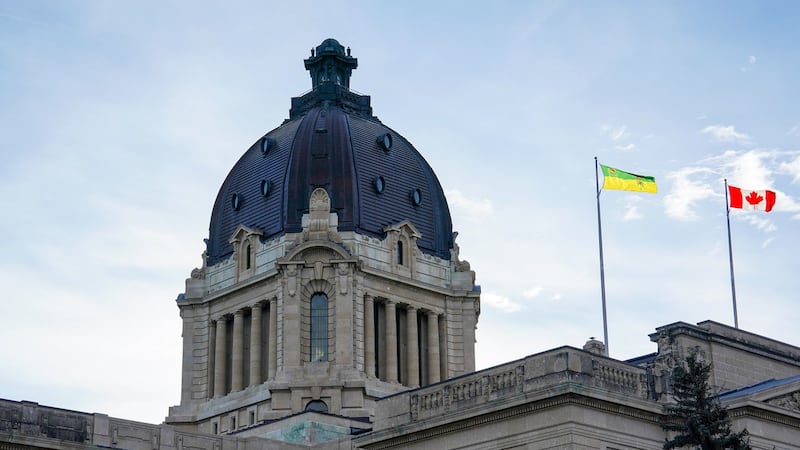
As U.S. President Donald Trump says he is closing in on a potash deal with Belarus, Premier Scott Moe continues to cast doubt on the feasibility of the deal and the logic around the U.S. shifting its supply of a crucial fertilizer component to an authoritarian state supporting Russia’s war in Ukraine. Speaking to CTV News on Tuesday at the legislative building, Moe pointed to numerous European nations that have turned away from Belarus as a supplier of resources like potash. “This is essentially stepping into the realignment of geopolitical allies around the world,” he said. “I would suggest that when Belarus’ closest neighbours are shifting their purchases of a product like potash to Canada and Saskatchewan away from Belarus and Russia, that the United States of America might want to have another look at this.” Moe first took to social media on Monday to comment on Trump’s plan to buy potash from Belarus, referring to it as “blood potash.” “If you’re going to purchase product from a place like Belarus, where President Lukashenko is actively supporting Russian aggression in Ukraine … you are very directly supporting that aggression,” he reiterated on Tuesday. In Monday’s post, Moe said buying potash from Belarus is wrong and doesn’t make sense, bashing Trump’s claim that Belarusian potash would be more affordable than potash sourced from Saskatchewan. Speaking on Tuesday, Moe said it also comes down to supporting a massive economic driver in Saskatchewan. “When you look at potash production globally, you know Canada is the largest producer, all of that coming from our province of Saskatchewan, but 70 per cent of global production comes from three countries: Canada, Russia and Belarus,” he noted. “We, I would say as global citizens, have the opportunity to choose, who are we going to support? Are we going to support Canada and Saskatchewan, which I would say is providing affordable, reliable, sustainable, ethical and available potash today,” he added, noting potash from the province would bring up to 50 per cent of global production. Further, Moe said Trump’s plan is not realistic, noting that Belarus shifted their sales east to China, leaving no supply left. “Where there is going to be potash available is in Saskatchewan,” Moe stated. “We see K+S is doubling their production. We are going to go from somewhere in the mid 30s of global production in this province, in this nation, to close to 50 per cent of global production.” “The supply chains are set up with the U.S. We ship about half of our exports to the U.S. It is a sustainable product. It’s an ethical product. It’s a product that the U.S. can purchase from a what traditionally, despite the current trade discussion, has been a longstanding ally.” Moe went on to say there are over 40 countries which have Belarusian potash sanctioned due to the country’s support of Russian aggression in Ukraine. In December of 2025 the U.S. agreed to lift sanctions on Belarusian potash after Lukashenko freed 123 prisoners with the help of Trump’s envoy. “The U.S. has been one of those countries in years gone by, but outside of that, there’s a global potash price. The price is what it is globally,” Moe said. “What will affect that price is the reliability of the supply, how ethically produced the supply is, and that is, I think, the significant difference between Belarusian potash and Canadian potash.” Moe acknowledged it is possible Trump may simply be posturing due to the ongoing trade disputes between the U.S. and Canada. “At the end of the day, Saskatchewan and Canadian potash companies are going to do very well in the global market because of how we produce the product, how the product is priced, the quality of the product, and I would say increasingly well in places that are on the front line of what they see happening with that Russian invasion of Ukraine,” he said. “If those countries on the very front line are refusing to buy Belarusian potash, shifting their supplies to a place like Canada and Saskatchewan, I think that tells you all you need you need to know about how they feel about Belarus supporting the Russian aggression in Ukraine.” Moe said despite the trade war with the U.S., he doesn’t believe Canada’s southern neighbour is subbing out its geopolitical allies for good. “I think we’re going to work through this discussion,” Moe noted. “As alarming it can be at times with the statements that are made. These statements are not real.” With files from David Prisciak and Kayla Thompson