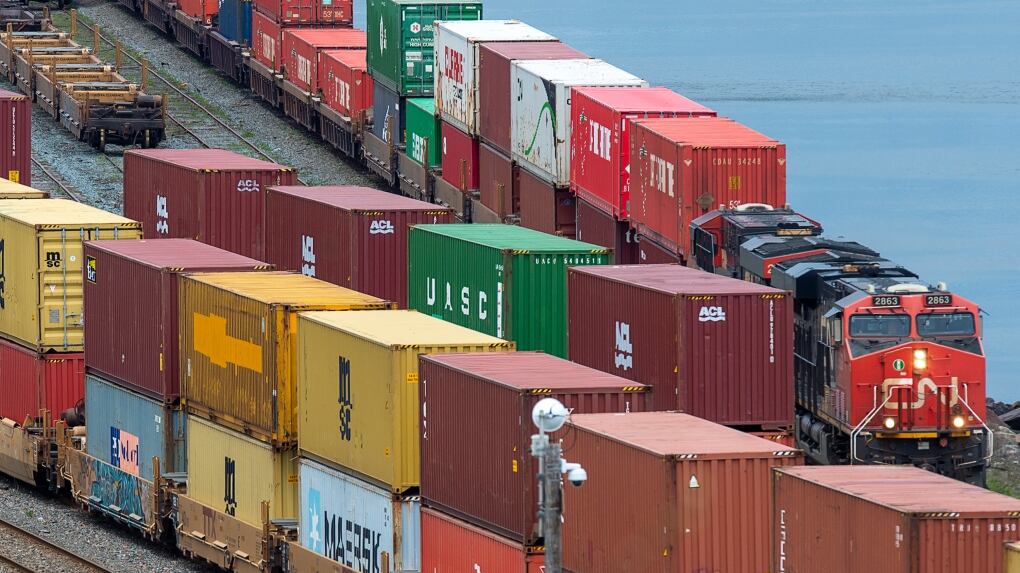
OTTAWA — Canada’s trade surplus narrowed sharply in July as exports of energy and metal products shrank while imports rose, just weeks before Washington’s new 50 per cent tariffs begin to show up in statistics, posing a stiffer test for Canadian exporters. The trade surplus was $769 million, compared with a four-year high surplus of $4.2 billion posted a month ago, Statistics Canada said on Thursday. Economists polled by Reuters had forecast a surplus of $3.57 billion in July. Exports dropped 2.3 per cent, while imports increased 2.2 per cent. Amid an escalating trade dispute with U.S. President Donald Trump’s administration, Canada has been seeking to reduce its dependence on its neighbor and largest trading partner. The U.S. accounted for 66.35 per cent of Canada’s total exports in July, down from 69.39 per cent in June and 72.64 per cent a year ago. However, Canada’s import dependence on the U.S. has only narrowed to 59 per cent in the last 12 months compared with 62 per cent in 2024. The July figures, Canada’s fifth consecutive monthly trade surplus, extended a run of relatively resilient Canadian trade despite more than a year and a half of U.S. tariffs. However, Washington’s latest duties, imposed last month, will provide a tougher test for exporters in the coming months. The decrease in exports in July was primarily led by energy products, which account for almost a quarter of Canada’s total exports, and 95 per cent of which usually flow south of the border. Their value dropped 4.4 per cent in July, a third consecutive monthly decline after exports of crude oil decreased by 5.5 per cent, with both prices and volumes falling, StatsCan said. Exports of metal and non-metallic mineral products, which posted an increase of 15.8 per cent in the prior month, also shrank by 8.5 per cent in July. As a result, Canada’s total exports fell to $76.14 billion, down from $77.96 billion in June, but excluding metals and energy, exports increased 0.6 per cent in July. The overall decrease in total exports in July was partially offset by higher exports of aircraft and other transportation equipment and parts, which surged by 34.9 per cent. Imports rose in July to a value of $75.37 billion, up from $73.76 billion, StatsCan said, adding that it was the sixth consecutive monthly increase. This was led by an 11.4 per cent increase in imports of motor vehicles and parts, mainly from the U.S. Exports to the U.S. dropped 6.6 per cent in July while imports from the country increased by 1.8 per cent, shrinking Canada’s trade surplus with its main trading partner by more than 40 per cent to $5.9 billion. Stuart Bergman, chief economist at Export Development Canada, the country’s official export credit agency, said that keeping the share of Canada’s exports going to the U.S. below 70 per cent was an encouraging trend. “Sheer gravity alone pulls exporters to the U.S. market,” Bergman said, but added that there have been concerted efforts to shift some of that gravity to other markets, citing the increase in agricultural exports, especially canola to China and Japan. Year-to-date share of exports to the U.S. is around 68 per cent, down from 73 per cent in the year-ago period. Exports to countries other than the United States rose 7.4 per cent, while imports increased 2.8 per cent, leaving Canada with a non-U.S. trade deficit of $5.1 billion, down from $6.1 billion in the prior month. The Canadian dollar was trading firmer, up 0.35 per cent to $1.3792 against the U.S. dollar, or 72.51 U.S. cents. --- Reporting by Promit Mukherjee; Editing by Dale Smith; Editing by Sharon Singleton