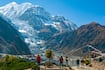
The towns of Banff and Canmore have experienced hot weather at the end of May, but that’s turning to days of rain in the forecast, and that has emergency services in both towns preparing for flooding. John Pomeroy, professor and director of Global Water Futures Observatories, is based in Canmore, and he and his team monitor water levels year-round. He says there was record snowfall in the mountain parks this year, and now it’s melting. “This year, the rivers are not up because of rain; they’re up because of snowmelt,” he said. “We have a record-deep snowpack in the northern part of Banff National Park, at the headwaters of the Bow River basin, that’s generating runoff right now.” Pomeroy says there’s a lot more water being held in that snow at higher elevations. “The snowpacks are saturated; it’s like a wet sponge,” he said. “So, any water you put into it is going to come out, and that warm rain will also melt that snow, and with strong winds, it will melt it even faster, so this is what we have to be on guard for.” Pomeroy says environmental modelling is much better now than it was in 2013, the last time the Bow River rose over its banks having a devastating impact on Canmore and Calgary. But he can use data from 13 years ago and compare it to what he’s seeing in the rivers now. “It wouldn’t be difficult to push it into some exceptional territory,” he said. “The warmth recently has been exceptional, so in some of our stations, we had 200 millimetres of snowmelt in the last week generated out of there, and the snowpacks are still deep; there’s still 700 millimetres of water ready to come out of that snow.” Keri Martens, Banff’s fire chief, has been monitoring the Bow River where it runs through town. “We’ve been watching the numbers come up, and we know it’s come up over the last couple of days,” she said. “Significantly, and you can see now it’s pooling over some of the lower-lying trails, so we wanted to start being proactive and lay out some flood mitigation.” Martens says the town has put a number of “tiger dams” into place that, when water is pumped into them, form a barrier to protect property from the rising floodwater. “A lot of folks in Banff have been through this multiple times,” she said. “We’ve had high-water events before; this one could be a little bit higher than we’ve seen for the last number of years, but most people are just happy that we’re working at stuff and we’re watching it and monitoring it.” The RCMP are asking people to be cautious around the rivers in the mountain parks. “Stay well back from the edge of rivers and streams. Fast-moving water can erode shorelines and pathways without warning, causing them to collapse,” it said in a release. “Closely supervise children when near water; do not wade, swim in or paddle on streams and rivers in the area at this time.” Police say conditions can change quickly. They say creek crossings that may have been passable earlier in the day can become dangerous as melting increases or with rainfall. Heat and rain increase avalanche risk, with large amounts of snow still present at higher-elevation areas. RCMP are asking the public to monitor local weather alerts and emergency notifications for potential flood risks in their area and download the Voyent Alert app for local emergency notifications. You can learn more about streamflow advisories and flood warnings at https://floods.alberta.ca.