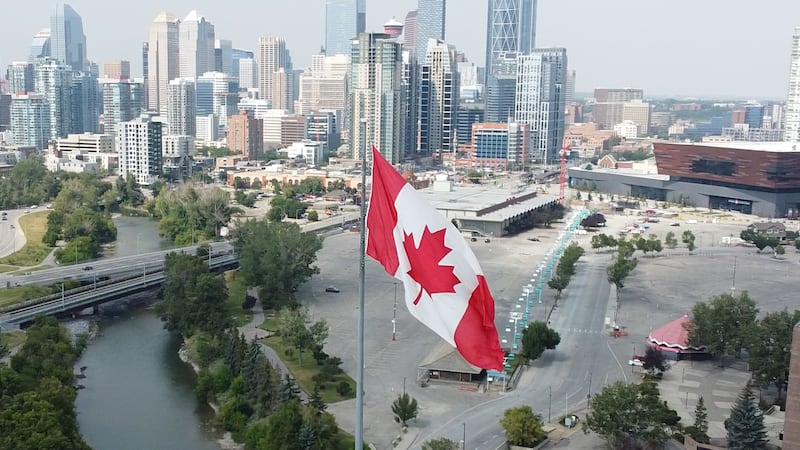
The ongoing and escalating trade war between the United States and Canada could cost the City of Calgary nearly half a billion dollars, officials said Tuesday. In an update to a city committee, administration estimated the potential “tariff risk” for existing contracts could range between $315 million and $466 million. “The majority of that is retaliatory tariffs. American tariffs (are) more or less equivalent to how the inflation rolls in. Because we are net importers of all the goods, we don’t really export anything. So the bigger impact for us is the retaliatory tariffs,” said Amit Patil, director of supply management with the city. Canada’s counter-tariffs on $28 billion of American goods went into effect Tuesday, including on dairy products, softwood lumber, appliances, steel, beauty products and dozens more. Mayor Jeromy Farkas said Calgary will pitch the federal government for tariff relief for the millions of dollars in expected additional costs. Only about five per cent of city contracts currently involve American suppliers, but the material needed adds up, Patil said. To try to mitigate potential tariff impacts, the city will continue to source supplies from countries outside the U.S. and is exploring whether it is cheaper to cancel or revise current contracts with American suppliers. “No. 1 is we want to make sure to validate everything that’s been claimed that’s part of the increase in tariffs. The team is really experienced in understanding what we need as evidence of what that all looks like,” Patil said on how the city is trying to evaluate and mitigate tariff impacts. “The second piece is looking at alternatives. Is it our specs that potentially are getting us to just buy from the U.S.? We have proven it through some of the (water-main) pipes getting through Mexico or some of the fabrication steel that is going through Europe.” Dozens of projects, contracts impacted According to city administration, Calgary could see increased costs on several major projects, such as the Green Line LRT, event centre, Bearspaw South feeder main and other water projects. Transit vehicles and fire trucks could also cost millions of dollars more. In a briefing to councillors Tuesday morning, transit projects and vehicles topped the list for potential cost increases. Calgary has $535 million worth of contracts for new buses and trains and could see the bill skyrocket by $84 million due to the trade war. Of the $1 billion in committed water infrastructure projects in the city, just over $20 million of it could be impacted by tariffs. The Green Line LRT project could also see costs climb by $31 million. Scotia Place, the new home for the Calgary Flames, could see a potential tariff impact of $30 million, some of which is due to specialized electronic equipment and video boards that need to be ordered from American suppliers. Plans for new fire trucks and equipment for the fire department could be $11 million costlier for Calgary, too. Tariff relief sought from Ottawa: mayor As part of the tariff impact update, council voted in favour of the mayor advocating to the federal government for help for municipalities dealing with higher costs due to the trade war. “I fully support the Prime Minister’s needed trade actions to be able to assert ourselves. And I’m hoping they’ll come to the table with negotiators in the coming days and weeks,” said Mayor Jeromy Farkas. “That said, it gives us an opportunity to navigate through an expedited tariff relief program,” he said. The possibility of higher costs will also be front and centre as Calgary prepares its next city budget, the mayor added. Millions of dollars in costs have already been incurred by the city due to the tariff situation, officials said. Between March of 2025 and August of this year, the city has paid $1.2 million more for various goods and services, with another $5.7 million in contracts under negotiation or under review.