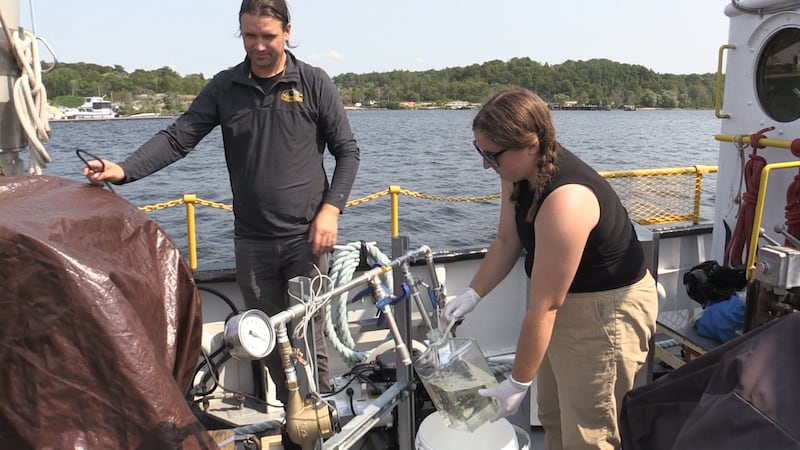
A free tool that tracks harmful algal blooms (HAB) in Alberta lakes has successfully launched online Wednesday. The website, algalbloomtracker.ca, uses satellite imagery to provide “near real-time monitoring” of algal blooms at six lakes – Ethel Lake, Lac La Biche, Sylvan Lake, Nakamun Lake, Pigeon Lake, and Wabamun Lake – chosen for their different characteristics. “We wanted our project to span that whole spectrum, so we really captured all of the lake types in Alberta,” Bradley Peter, with Alberta Lake Management Society (ALMS), said. The new tracker is the result of a three-year collaboration of 12 Alberta organizations – including ALMS, the Alberta Biodiversity Monitoring Institute and the University of Alberta – with the aim of supporting environmental reporting, public awareness and decision-making. Peter said “hundreds and hundreds” of water samples were collected from the lakes to build an algorithm for the HAB tracker, which now converts live satellite imagery into a “concentration of algae or chlorophyll on the lake.” Rolf Vinebrooke, a professor of aquatic ecology at the University of Alberta, said the team focused on Pigeon Lake as a “test model.” The large lake, which spans around 100 square kilometres, has varied water quality that cannot be captured by a single sample. “Using a satellite-based approach, it gives you whole lake numbers integrated over the entire lake surface – as opposed to just a spot water sample – and so it allows you to quantify more accurately how severe a bloom happens to be,” Vinebrooke explained. Both Peter and Vinebrooke said the goal is to expand this monitoring approach to more lakes in the province. “HAB can present health challenges for people, livestock, (and) pets. It can also negatively impact the economy, tourism, (and) recreation. So it’s really important to scientists, decision-makers, and local residents to better understand HAB in Alberta,” Peter said, explaining the significance of the online tracker. The website also includes historical data going back nearly a decade to 2017, which can help spot patterns and offer long-term insights about the effect of climate change on bloom conditions. Cyanobacterial bloom advisory for Matchayaw Lake On Tuesday, Alberta Health Services (AHS) issued a health advisory for Matchayaw Lake, also known as Devil’s Lake, in Lac Ste. Anne County. The advisory asked residents and visitors of the lake to take safety precautions, including not to swim where blue-green algal blooms are present, and not consuming any of the lake water. It also advised to keep pets away from the blooms in both the water and on the shore. Jurgen Preugschas, the Reeve of Lac Ste. Anne County, said summer is peak season for algal blooms and that the “tracker itself can be quite advantageous” to lake communities and those planning to visit. “It turns environmental monitoring into an actionable item and so I think it’s very positive,” Preugschas said. Additional information on cyanobacteria and potential health concerns can be found on the AHS website. Algal bloom season ends in early October. With files from CTV News Edmonton’s Miriam Valdes-Carletti