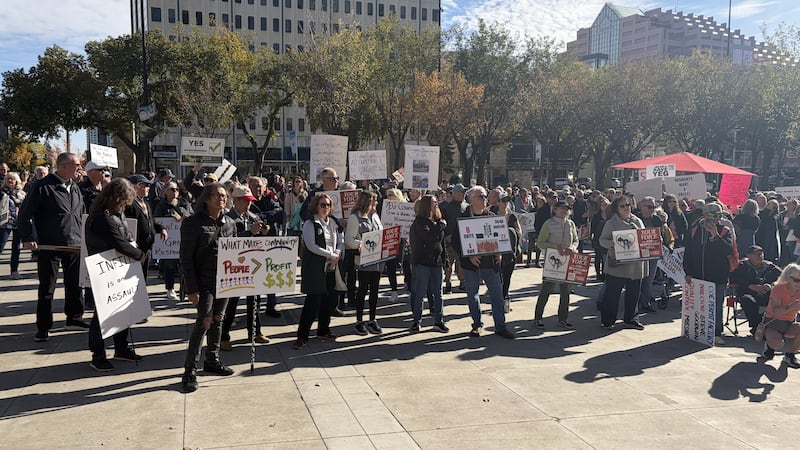
The Alberta government says forcing the City of Edmonton to fix high-density housing bylaws fall well within the province’s powers, despite critics saying the move undermines municipal autonomy. Under the Municipal Government Act, the province can take responsibility for regulating industry, development, building codes and other spaces. Section 694 allows the province to direct a municipal government to amend its land use bylaws. Premier Danielle Smith announced Thursday morning that the province was intervening in Edmonton’s infill development rules, giving the capital city three months to revert its bylaws back to pre-2024 standards. Smith says the changes were in response to homeowner concerns surrounding housing types, density and heights. Mayor Andrew Knack, however, called the move an “ultimatum,” saying the decision was an uninformed one made hastily in an “overreach” of power. But Alberta Municipal Affairs Minister Dan Williams says it’s the provincial government’s prerogative to step in when city residents feel they aren’t being heard. “There is a reality that we need housing that is not only built responsibly, but also respects neighbourhoods that they’re in,” Williams told reporters at an Edmonton press conference. “It’s too much, too fast, and it’s changing the dynamic of our neighbourhoods and disregarding the communities that they’re entering.” He said the move was about restoring the “right balance” to Edmonton infill conversations that collaborate with all residents and both levels of government: “not an ultimatum, but a conversation.” Has this happened before? University of Alberta political scientist Jared Wesley says while the provincial government is legally within its rights, the move gets dicier when there are no governing United Conservative Party MLAs in the City of Edmonton. “A lot of right-wing governments across Canada are finding themselves at odds with progressive city councils, and this is another example of that,” he told CTV News Edmonton. He pointed out that current zoning bylaws were created by city council and reinforced directly after an election, where most councillors ran on the post-2024 plan. “This is a clear case of the provincial government wading into municipal decisions, something that they’re allowed to do. But I think citizens, particularly in Edmonton, are right to ask if they should be doing so.” Infill is not the first time the province has moved to directly influence municipal affairs, Wesley added. Alberta’s minister of transportation, for example, plans to introduce legislation this fall surrounding bike lanes in Edmonton and Calgary which could include impact assessments and ripping up infrastructure should it not meet provincial standards, although Devin Dreeshen has kept most details close to the vest. Any move would interfere with Edmonton’s ongoing bike lane infrastructure discussions as the city works to build new projects. Thursday’s move by the province was, however, “the first time that we’ve seen a provincial government step in and threaten to withdraw a bylaw of this nature, of this magnitude.” “I think the Smith government’s path to victory in Edmonton seats in the last provincial election was difficult … This decision today makes it even tougher,” he said. “I don’t see how this makes the Smith government more popular in a city that they’re already massively unpopular in.” Speaking to reporters, Williams maintained that the province would not be degrading Edmonton’s autonomy rather than offering a “light touch” of guidance. He added that critics who say pre-2024 levels would upend municipal plans entirely are contributing to a “narrow, pigeonholing false dichotomy.” “There are many versions of densification that are gentle, that are thoughtful, that are done in a balanced way.” With files from CTV News Edmonton’s Brittany Ekelund and Chelan Skulski