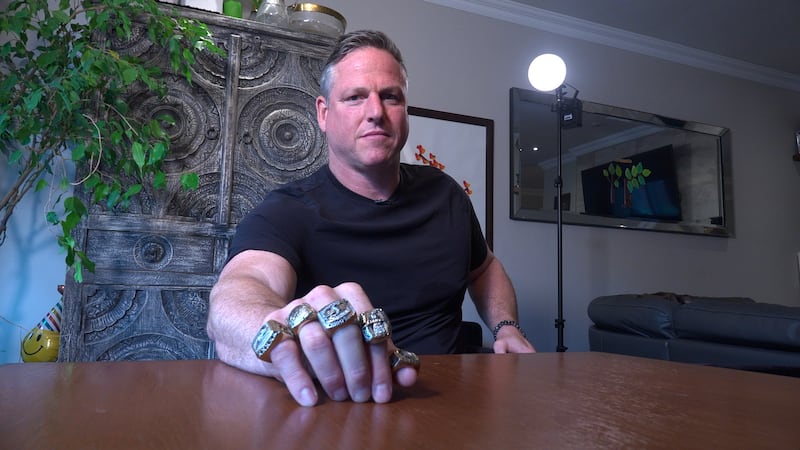
This is part one of a three-part CTV News series about the effects of chronic traumatic encephalopathy (CTE) and efforts to diagnose the neurodegenerative disease in life. In Part two, we will have more on the Toronto lab at the centre of Canadian efforts to detect it in a living research participant. Part three will have more on protecting young athletes coming up through sports federations. Four-time Grey Cup winner Tim Fleiszer says over the course of his career he was diagnosed with three concussions. When asked how many he thinks he may have had, he estimates anywhere between 50 to 100. “The worst concussion that I had was my rookie year Labour Day game opening kickoff,” he recalled in an interview. “I was the wedge buster. I was right in the middle. When you watch the play on film I look like a bowling ball hitting bowling pins. I jogged back to the sidelines, looked up at the scoreboard, and there were 12 minutes left in the second quarter, and I said [to] the guy next to me, ‘They’ve screwed up the clock.’ He’s like, ‘Yeah, you need to go see the trainer.’” After spending nine years as a CFL defensive lineman with the Montreal Alouettes, Hamilton Tiger-Cats, Ottawa Renegades, Edmonton Eskimos and Saskatchewan Roughriders, Fleiszer is now the executive director of the Concussion Legacy Foundation and has gone through preliminary testing for chronic traumatic encephalopathy (CTE). It’s a neurodegenerative disease that researchers with Toronto’s Centre for Addiction and Mental Health say is caused by repeated hits to the head. Currently, it can only be diagnosed after death through a brain autopsy but there are efforts to diagnose it in a living patient. Researchers say it can be prevalent in contact or combat sport athletes, military veterans, and victims of intimate partner violence. Severe cases of CTE can cause mood and behaviour changes, aggression, depression, and memory loss. A 2026 study in the British Medical Journal found that out of a sample of former NFL players who died between 2016 and 2021, 25 per cent had CTE. Boston University found in 2024 that 18 out 19 amateur and professional players sampled also tested positive for CTE. It adds the likelihood of developing the disease increased by 34 per cent for each year played. Former NHL enforcer Chris Nilan has also gone through cognitive screenings. Over the course of his 13 seasons in the NHL, he scored 110 goals, though he is better known for his 3,043 penalty minutes. “I loved the game and I love the aggressive nature of the game,” Nilan told CTV News. “I didn’t come in thinking, ‘Oh, I’m going to be a fighter,’” He recalls it was a scrap that made him stand out and ultimately led to a contract with the Montreal Canadiens. “I went out and I ended up hitting this guy and it turned out he was the reigning heavyweight of the American Hockey League. We got in a fight and I ended up cutting him open and did really well in the fight. So, the next day I thought I was in trouble. The coach finally sat me down in the locker room and said, ‘Do you have an agent?’ I said, ‘No, why?’ He said, ‘The Canadiens want to sign you to an NHL contract.’ And that was one game, one fight.” He said in the 1980s, information about head injuries and the long-term effects wasn’t as well known among players. “I hit my head. I saw stars a couple of times during my career. I didn’t believe it was a concussion because I didn’t know what a concussion was,” he said, adding that often he would be back on the ice just minutes later. It’s not just men’s hockey where that attitude was common. “Back when I played, we didn’t have doctors on the bench, especially for our club teams,” said former Team Canada women’s player Cassie Campbell-Pascall. “I remember one of the biggest times I got my bell rung, it ended up being a neck injury as well and I was out the next shift.” She says over the years she realized the toll the sport was taking on her body and brain. “It’s my brain is being chipped away at and it’s something that I’m very cognizant of,” she said. Campbell-Pascall has pledged to donate her brain to the Canadian Concussion Centre at Toronto’s Western Hospital, along with Olympic rugby sevens player Jen Kish, downhill skiing champion Kerrin Lee-Gartner and fellow hockey player Fran Rider — the first four female athletes to do so. Prior to their commitment, the centre had analyzed the brains of 44 deceased athletes — all male. “The fact that not many female athletes have donated their brain to science I think shows that we need more research and not just research based on the male body,” Campbell-Pascall said. CTE has been positively diagnosed in NHL Hall of Famers Bobby Hull, Stan Mikita, and 11-time Stanley Cup Champion Henri Richard. Richard’s son, Denis, recalls only the tail end of his father’s playing days but the memories of his degrading health are much sharper. “When you see a parent in decline and inevitably, he can’t go back in time, is it disappointment? Is it rage?” he told CTV News. He says watching his father, who was known for his physicality despite being on the smaller side, began to be confused and get lost in his neighbourhood and own home was extremely difficult. In his last days, Richard was a shell of the powerhouse player he once was. Upon his death in 2020, Richard’s family donated his brain and it tested positive for stage 3 CTE. In 2018, a group of former NHL players and the league settled a class-action lawsuit regarding brain injuries. The case alleged the league “knowingly concealed information regarding the risks of brain trauma while playing in the NHL,” including an increased chance of developing CTE. To this day, the league and commissioner have not acknowledged a direct causal link between brain injuries and the disease. For those athletes who have been tested, there are no answers yet. “If you are diagnosed with it, how do you stop it?” asked Nilan, adding that, “getting people to start talking about it is key. People have a tough time to do it, and I understand that because I was one of those people at one time.” Fleiszer says his priority is to be able to tackle the disease head-on. “You can’t treat a condition that you can’t diagnose, so being able to do that will be a game-changer,” he said. “We can think about treatment strategies, we can start to measure the effectiveness of them, we can see how the disease is progressing. I’ve always already done the math on wanting to see my kids get married and for me to see my grandkids. I want to make sure that I’m around and present and cognitively sharp for all to be able to enjoy all of it.”