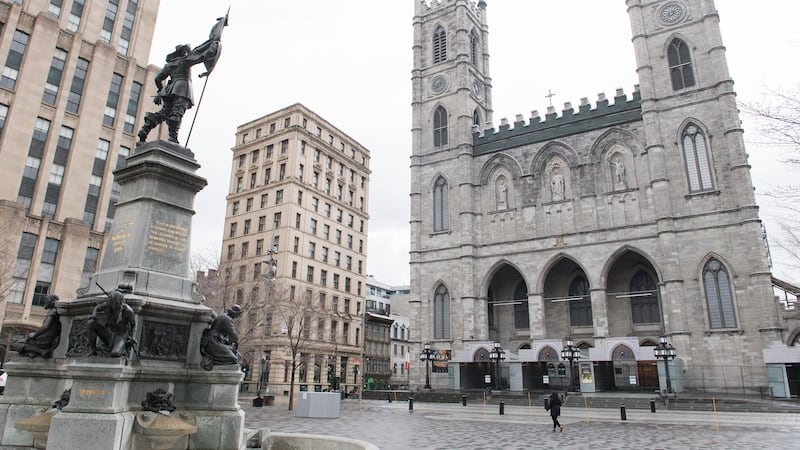
After 10 years behind scaffolding, Montreal’s Notre-Dame Basilica is preparing for the grand unveiling of its façade on Oct. 25. A free concert by the New World Philharmonic Society and organist Jean-Willy Kunz is planned for the occasion. Seats inside the basilica have already been fully booked, but those who were unable to secure tickets in time will be able to admire the restored façade while enjoying an open-air performance in front of the basilica before the concert begins inside the church. Despite the restoration of the façade being complete, the basilica still has several years of work ahead of it. Around 20 per cent of the necessary work has been completed, according to Michel Issa, general manager of the Fabrique de la paroisse Notre-Dame de Montréal. He estimates that the work on the exterior of the church will take four years, noting that this figure may be on the optimistic side. For the restoration work inside the basilica, he anticipates a further five to 10 years. The total cost of the restoration, both interior and exterior, amounts to $100 million, according to Issa. To fund this work, the basilica organizes charity concerts, generates revenue from its Le Firmament café — in partnership with the Café Saint-Henri chain — and runs fundraising campaigns. The latest fundraising campaign is based on a new idea: leaving a virtual mark on the church’s stones. Donors have the option to “sponsor a stone” and inscribe a digital message – which may be private or public – on the façade of the building. “We would have liked to engrave the stones themselves, but, unfortunately, it’s a logistical nightmare that’s impossible to pull off,” said Issa, adding that the process would reduce the stones’ durability. The messages will be visible, via a mobile phone, directly on the church’s façade using augmented reality, or elsewhere by projecting a model of the façade onto a flat surface. The augmented reality process is similar to that used a few years ago by the viral app Pokémon Go, Issa noted. While it is already possible to sponsor a stone, the messages will only be viewable from the next phase of the project, in early 2027. A complex job The reason the works require such a large amount of funding is that they involve the entire structure. “All the masonry needs to be reinforced and restored throughout the building,” said Mathieu Verreault, director of tourism and operations at the basilica. “After years of freezing and thawing, the stone has eventually cracked in several places.” The stones used to build the basilica came from an old quarry in Mile End. Those used higher up were salvaged from the bottom of the quarry and were of poorer quality, noted Verreault. On top of that, some were laid “the wrong way round”. “It’s sedimentary stone, so there are layers, and they need to be laid horizontally. “If you lay them vertically, the stones are more permeable to rain,” he explained. Some of the mortar holding the stones in place was also replaced with epoxy in the past, which had the effect of putting greater pressure on the stones. “People were doing the best they could with the knowledge available at the time, and, obviously, in the long run, all these choices—which have proved questionable over time—have led to the situation we see today,” Verreault said. The external weaknesses also affect the interior of the building, with water penetration and damp problems leading, for example, to the deterioration of painted decorations. These, incidentally, are not being repainted. Instead, the parish is attempting to reattach every bit of paint. A process that Verreault describes as “very labour-intensive, very time-consuming, but it is best practice in heritage conservation.” The basilica’s star-studded blue vault is one of the areas that will need to be restored. “We’re talking about scaffolding about 10 storeys high, which means our music concerts and guided tours will most likely be suspended,” which will cut into the church’s income, Issa added. If the work is not carried out, the deterioration threatens to progress exponentially, causing even more problems in the future. This report by The Canadian Press was first published in French on Oct. 10, 2026. Alexis Drapeau-Bordage, The Canadian Press