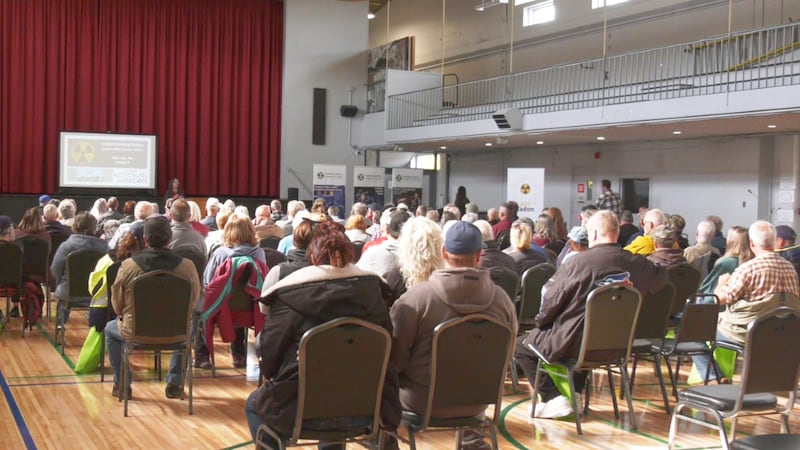
Health officials say an invisible, odourless gas is the leading cause of lung cancer in non-smokers -- and the only way to know it’s in your home is to test. This week in Elliot Lake, hundreds of free kits were handed out to help residents do just that. Dozens of residents packed into Collins Hall on Oct. 8 to learn more about radon and to pick up a free at-home testing kit. “We moved here in October last year, so we’ve been here a year,” said Elliot Lake resident Rosie Campbell. “And when they bought the house, they asked us if we wanted the radon test. At the time, we said no, but I think we should know what’s going on in our houses.” “An understanding of how much of this is in the area,” said another resident, Lana Pulli. “Like, is it something all in the area? Is it specific to certain areas? I think it’s important to find out so people don’t get sick inside.” Now in its ninth year, the 100 Radon Test Challenge is a national initiative funded by Health Canada to distribute home testing kits to communities. The test includes a small puck placed inside the home for 90 days, which is then mailed away for analysis. The event was organized by the non-profit agency Take Action on Radon and the Radiation Safety Institute of Canada, which was originally started in Elliot Lake in collaboration with Algoma Public Health. “We want to hear (about) how people know about radon and their perspectives, over the years, from a group of people that may be new to it but may have a lot of historical knowledge,” said Pam Warkentin of Take Action on Radon “We want to share what we know and some of the research that’s coming up.” Anne-Marie Nicole, an epidemiologist from Simon Fraser, was on hand to answer questions. “We know that still less than half of Canadians actually know what radon gas exposure is,” Nicole said. “And (fewer) of those people know that it causes lung cancer. So chronic exposure to radon is the second-leading cause of lung cancer in this country. And it’s the first, if you don’t smoke.” Elliot Lake’s history as the uranium capital of the world means natural radon levels in the soil are higher than in most places. The city’s unique geology led to it being specifically written in the Ontario Building Code, requiring radon barrier protection for homes built in the city. “As a result of the conditions in the mines a long time ago, the miners were coming down with excessive cases of lung cancer and silicosis, which is caused (by) exposure to silica,” said Lynn MacDonald of Radiation Safety Institute of Canada. “So air conditions at the time were not great. And from there were changes that ended up happening that impacted health and safety across Canada.” “In 1976 and 1975 era, when the cleanup of nuclear waste in Canada came to Elliot Lake to clean up some of the waste that shouldn’t have been used … they figured, well, there’s quite a bit of problems with that around houses,” said Luc Lance of Algoma Radon Testing. “The miners going to work every day (were being) exposed to radiation and then coming back home, being again exposed to radiation. You include those two numbers. That’s a pretty high risk of getting lung cancer.” For those interested in picking up radon testing kits, free radon testing kits will be available over the next week at Algoma Public Health’s office, located inside the Elnos Building on Nova Scotia Walk.