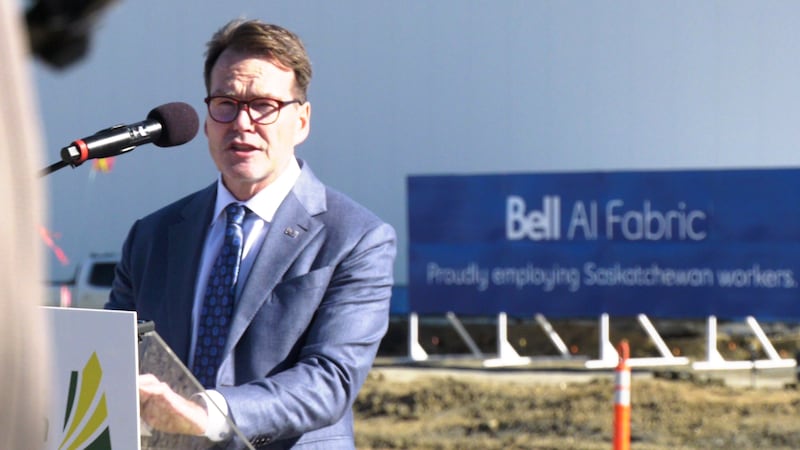
Rechie Valdez, the Minister of Women and Gender Equality and Secretary of State, was in Sudbury on Thursday to announce funding to support survivors of violence in rural and remote communities. Valdez was joined by Sudbury MP Viviane Lapointe to announce $472,100 for She Matters, a survivor-led non-profit organization in Sudbury dedicated to supporting survivors of sexual violence and domestic abuse. “We know that there are high rates (of sexual violence) across the country. When it comes to femicide, women who are fleeing sexual violence situations, there’s no single bullet solution that can tackle this,” Valdez said. “So, this is one very specific project that’s helping a community grassroots organization.” She Matters founder Jacqueline Villeneuve Ahmed and health equity researcher Victoria Donkin also spoke at the announcement. The funding is a federal funding top-up to support the ongoing initiatives of two projects across Canada. The first is an extension of a project called ‘Does Geography Impact Access?’ in which the organization spoke with survivors and service providers. “It was to be able to understand when a survivor enters a hospital or is not able to enter a hospital due to distance, time, geography, etc., what that pathway looks like,” Donkin said. “The additional funding we receive today for that project is to explore the barriers for minors and youth who have experienced sexualized violence across Canada.” Donkin said the funding will investigate why young survivors are falling through the cracks. “Currently, hospitals that do have a sexual assault evidence kit for adults, they don’t necessarily take youth and minors for that same process,” she said. “Whether it be because they don’t feel comfortable, like they don’t feel like they’re trained enough to do that same care and protocol with a child. That’s what we’re trying to figure out. Why are you being turned away from the hospital? Even if they do have a kit.” The second project the funding will support is called Bridging the Gaps, which focuses on supported self-collection. Must travel a long way “Survivors in rural, remote and northern communities are not able to enter a hospital after they have experienced sexualized violence to receive forensic care,” Donkin said. “Forensic care is evidence preservation, but also lifesaving care for HIV prevention, STI testing, pregnancy prevention or even wound care if they have experienced immense physical injury post-assault.” Donkin said survivors in remote and rural communities must travel long distances to receive care -- sometimes upwards of five hours. “A lot of the time, they come to a hospital that is supposedly supposed to have this care, but they either do not have a sexual assault evidence kit on site, or they don’t have a trained professional on call to be able to administer that kit and provide that care,” she said. “So they’re then waiting at the hospital for 12 plus hours for someone on call to be able to provide that care or bring a kit.” She added that survivors in remote areas face the ordeal of preserving evidence for hours — avoiding food, water, or the restroom — only to endure exhausting journeys and lengthy emergency room waits. Asking too much of survivors “We’re expecting too much of survivors to be able to live through what has happened and to be able to preserve their choices, because ultimately, collecting forensic evidence is part of the pathway to the criminal justice system,” Donkin said. The funding for the work was originally given to the organization by the federal government in 2025 and will support the project until 2028. Lapointe said that the work is important. “The research She Matters is doing is so important because it tells us what are the gaps in terms of the services that victims can access,” she said. “What are the gaps and what do we need to do to be able to address those gaps so that services are available to victims of these crimes?” Donkin said the work will bring hope to survivors. “It’s a lot of hope for communities that don’t have preservation options, that this could be implemented in Canada,” she said. “For the Gaps in Care for Minors projects, for survivors themselves who have experienced sexualized violence as a minor, I think it’s bringing comfort that this call to action will be brought somewhere.”