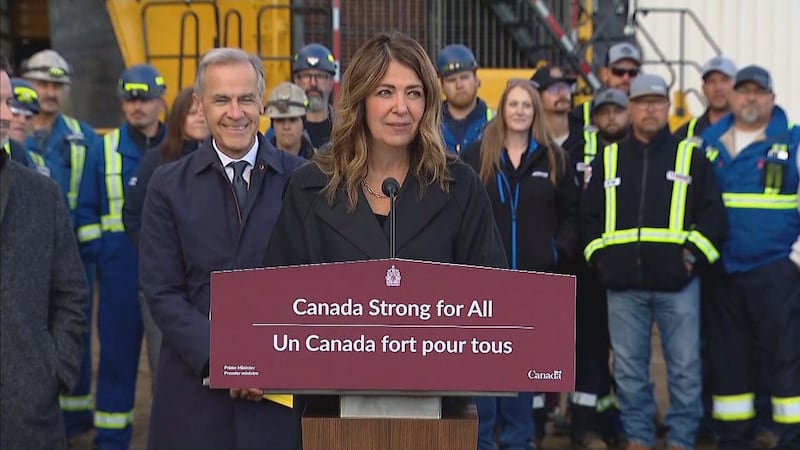
Alberta Premier Danielle Smith called the advancement of a new pipeline on Thursday a “significant victory” for Alberta and Canada. The Pacific Link pipeline to the West Coast was announced by Prime Minister Mark Carney in Fort McMurray, Alta., as the first project of national interest under the Building Canada Act. Construction could start as soon as Sept. 1, 2027, following a “streamlined” review process. The cost of the project is estimated between $35.2 billion and $43.7 billion, to be split between the federal Crown corporation Trans Mountain Corp. and the Alberta government. Pembina Pipeline Corp. has also expressed interest as a private-sector investor. “Today sends a clear message: Canada is ready to build,” Smith said at the announcement. “The challenge has never been whether Canada has resources to offer. The challenge has always been getting those resources to the markets that need them most, and this project helps to solve that problem.” Richard Masson, former CEO of the Alberta Petroleum Marketing Commission, called the announcement “huge” for Alberta. He said it felt similar to the 1990s declaration of opportunity penned by Liberal Prime Minister Jean Chrétien and Conservative Alberta Premier Ralph Klein. “We changed the fiscal system to support the oil sands being developed and it resulted in a wave of investment, new technologies, many, many process improvements and hundreds of billions of dollars of investment,” he said. “What (this announcement) is essentially doing is changing from the way we were looking at the world over the past 10 years to a new way that says Canada has world-class resources and world-class people, we can develop them in an environmentally responsible way and we want to develop them.” The government of Alberta said the new pipeline is estimated to produce more than $265 billion in royalties for the province over its 50-year lifespan. Smith said it could create up to 140,000 jobs during construction, as well as another 50,000 annual jobs when complete. The governments of Canada and Alberta signed a memorandum of understanding in November to “strengthen energy collaboration and build a stronger, more competitive, and more sustainable economy.” Smith said, in reference to the upcoming referendum question asking if Alberta should stay in Canada, that the advancement of the project is proof of the power of a unified country. “I don’t like the fact that many of our fellow citizens have given up on Canada,” Smith said. “This is one example, along with the work we’ve done over the last year, I think, of demonstrating that cooperative federalism can work in action.” “Canada is working,” Carney said. “We came together, we looked at an opportunity, and this opportunity is unlocked by Canada as a whole.” The pipeline project is projected to cost about $4 billion from now until next September. The Canadian Press reports that a government official said those costs will be paid initially by the Canadian and Alberta governments. Alberta NDP leader Naheed Nenshi said in a Thursday media release that his party had been advocating for a southern-route pipeline and was “pleased” to see the project move forward. “We consulted extensively with industry to realize this route was the most feasible and most likely to get built, before actively advancing it with the most senior levels of the federal government and the public,” Nenshi said. “Now we are at the same point we were a decade ago when Alberta’s NDP government got a pipeline built. The hard part of getting this project completed begins.” With files from The Canadian Press