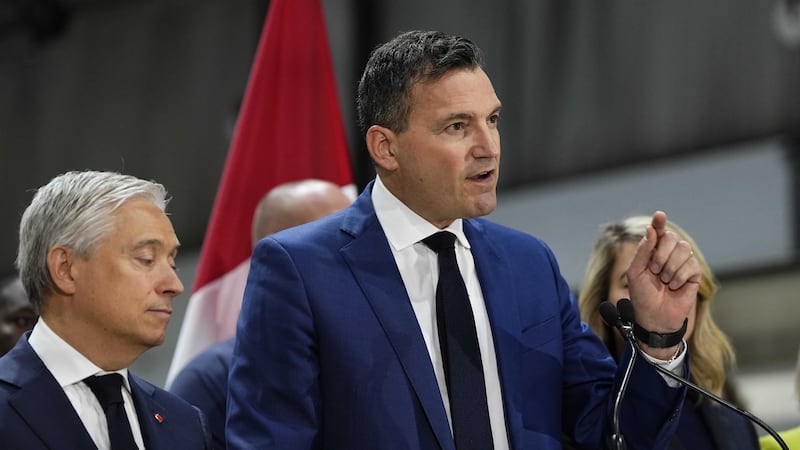
Greater Sudbury is on its way to becoming the first municipality in North America to add automated external defibrillators (AEDs) to its entire transit fleet. At a news conference Sept. 8, transit director Brendan Adair said the city has 63 conventional buses and 15 specialized buses. Aaron Archibald, the city’s paramedic services chief, said time is critical when someone is in crisis. “For every minute where there’s no CPR, your likelihood of survival decreases,” Archibald said. “By having AEDs strategically placed on every bus that’s traveling throughout our community, when you have that aid, coupled with early, quick CPR, the rate of survival increases.” An AED allows anyone to step in with life-saving measures for someone in crisis. Archibald said the machines have a speaker that instructs users on what to do. “They will actually prompt you and walk you through how to do CPR, when to do CPR,” he said. “So it’s important to note that anybody can use this in an emergency. It could be a bystander, it could be a transit operator, it could be an off-duty paramedic -- anybody.” Christine Russell with Zoll Canada said there are 60,000 sudden cardiac arrests every year in Canada. “That’s one every nine minutes, and over 70 per cent of those happened outside of a hospital environment,” Russell said. City council approved the project in 2024, and officials estimate all GOVA buses will have AEDs on board by October. “On our conventional system, they’re going to be stored at the front of the bus, on the wheel well, and in our specialized service with a different ... set up, they will be at the front and supported by that bus operator,” said Adair. “If you think about all of the kilometres a year and all of the geography that an AED or a bus drives, what happens is that we have safety embedded into the map of Sudbury,” Russell said. Officials with paramedic services said the AEDs don’t replace the need to call 911. AEDs are a quick and accessible step, but not the whole process.