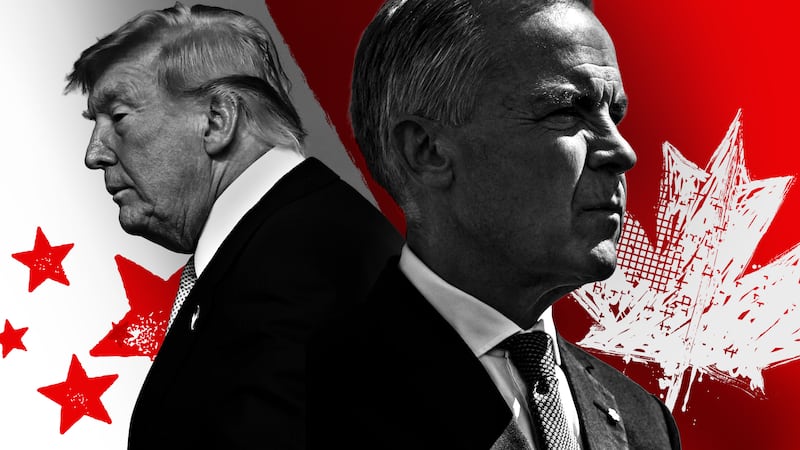
STRASBOURG -- Prime Minister Mark Carney said an enhanced partnership with the European Union will be put up for debate and a final vote in Parliament. During a news conference in Strasbourg, France, on Thursday, the prime minister added that Canada is not looking to become a full member in the European Union and stressed that this is “a different framework.” “Yes, we will have a series of debates, I’m sure, in Parliament, relevant committees, and ultimately there will be a vote in the Canadian Parliament for the final structure of the alliance that we’re working on,” Carney said during a news conference alongside Roberta Metsola, president of the European Parliament. “The next important point is the summit, European-Canada summit in Montreal at the 29th and 30th of October, but it will all roll out transparently. It’s an exciting time because this is an opportunity to speak for Canada. Make Canada stronger, more sovereign, more independent, more prosperous, more sustainable.” Carney said the “nomenclature” of how to frame the new alliance would be determined by the EU, but that the substance of a new arrangement is more important than its name. Similar debate will happen in the European Parliament. “We look forward and positively at new opportunities with allies such as Canada, with whom we have had partnerships and alliances, call them what you will, for hundreds of years,” Metsola said. “The overwhelmingly positive reaction of members in plenary just a few moments ago will be reflected in a similar reaction in the committees, of that, I have no doubt.” In an earlier address to the European Parliament, Carney said he welcomes the ambition of European Council President Ursula von der Leyen to see Canada become the first associate member of the EU. “We welcome this ambition -- polling shows an overwhelming majority of Canadians support much closer ties,” he said in his address Thursday. His remarks come after Canadian officials previously downplayed the characterization of a deeper relationship with the European Union as being an “associate member.” Canadian officials continue to stress that a specific name for that enhanced partnership with Europe still needs to be determined. Carney said Canada and Europe should have deeper ties on critical minerals, defence, artificial intelligence and energy security. He said the two should move forward in allowing young people to live, work and study on either side of the Atlantic, and create an integrated market for financial services. Metsola said this could include Canada joining the Erasmus+, which is a program that facilities student exchanges between member countries. “If you ask our young people what they associate the European Union with, I would tell you Erasmus is the first thing they mentioned. Horizon is the second thing they mention in terms of opportunities that with Canada could only get bigger,” she said. Horizon Europe is the EU’s program that puts funding into various research and innovation projects. The program’s budget for 2021-2027 is worth about $150 billion. Carney did not mention U.S. President Donald Trump by name, though his speech alluded to strained relations between both Canada and Europe with the American administration. “We are not fair-weather allies. We do not pursue zero-sum deals. Our commitment to the rule of law, and our unyielding defence of human dignity, individual freedom and democracy share the same deep roots, the same unwavering dedication,” Carney said. “We hold common values, for which we have always fought, and in whose defence we must always remain vigilant.” U.S. President Donald Trump said Wednesday he views Canada potentially becoming an associate member as a “hostile act” in the trade war and threatened more tariffs against Europe. Carney said a deeper alliance will make Canada a “better partner with the United States.” “Canadians are united that nobody is going to tell us what language we speak, no one going to dictate our culture or with whom we can strike agreements. Internationally,” Carney said. In his address, he also sketched out what he does not envision in a new partnership with the EU. “I am not proposing a third bloc in order to become a great-power rival -- only with better manners,” he said. “We do not seek power to dominate others. On the contrary, we are pursuing resilience so that no one can control our open markets, impair our sovereignty, threaten our territorial integrity, or undermine our freedoms, our democracies, our rule of law.” Conservative MPs have suggested associate membership in the EU might compromise Canadian sovereignty. They have warned of chaos from open borders, heaps of tax revenue going to Brussels and newcomers taking Canadian jobs -- though it’s not clear that any of those changes would come from associate membership. Ten of 27 EU countries still haven’t ratified a trade deal with Canada that has been in place provisionally for nine years. Canadian businesses have not taken up market access provided to them in Europe to the same extent that European industries have in Canada. Nick Murray, The Canadian Press With files from David Baxter in Ottawa This report by The Canadian Press was first published Sept. 17, 2026.