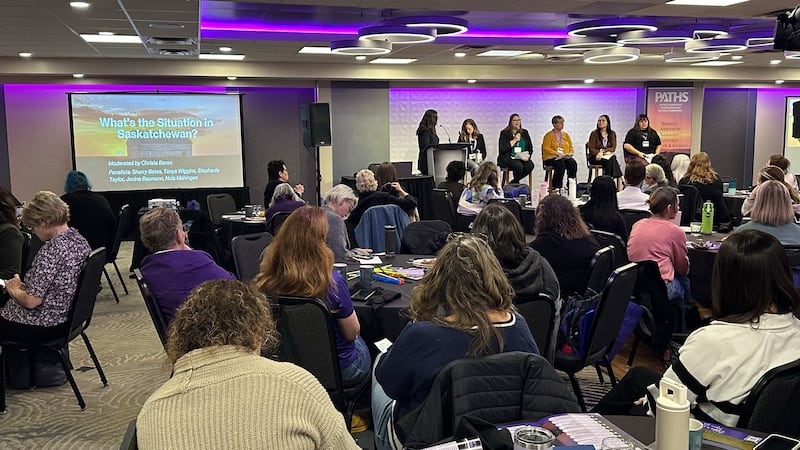
Access to housing and transportation remain the key barriers for Saskatchewan women who are fleeing from intimate partner situations. Every two years, Provincial Association of Transition Houses and Services of Saskatchewan (PATHS) organizes a conference to examine the challenges intimate partner violence survivors and services face. The event also brings forward opportunities to strengthen prevention and response across the province. This year, a panel of five leaders from across Saskatchewan – specifically from Yorkton, Regina, Prince Albert and Saskatoon – shared the barriers their services are seeing when dealing with government programs, family court proceedings and youth education. The common themes are barriers to accessing housing and transportation for people who are seeking assistance from intimate partner violence. Shortage of housing for survivors After going to an emergency shelter for help, many women do not have a place to go afterwards, explained Nola Mahingen. “If they have no place to go, they’re usually going back into their same situation,” she explained. “They’re going back into their same homes, back into their same communities. There’s not a lot of services available.” Mahingen is the executive director of Safe Haven and Eagle Sky Healing Centre – a shelter and addictions and mental health treatment centre organized through the Yorkton Tribal Council. She added that its outreach services are offered to six First Nation communities and without access to second-stage housing, survivors continue to loop back into vulnerable situations. “There’s addictions that are involved. There’s different types of addictions that lead to and lead from interpersonal violence into intimate partner violence,” Mahingen explained. “Domestic violence happens when there’s addictions and when you are dealing with that, you may go to those addictions as well … The biggest thing is now that we’re connecting all these different issues that we need to work around.” Prevention: teaching youth about healthy relationships Sherry Bates, executive director of Prince Albert Safe Shelter for Women, said the biggest hurdle has been getting the children of survivors who are staying at shelters enrolled into schools within the city. “Children staying at our facility, because we are just outside of city limits, we do have little schools, but our clients are being denied access to education because of the situation that they’re in,” Bates explained. “… Being allowed to enroll in the public school system in Prince Albert, they’re encouraged to attend their home school or the school district that they came from, but oftentimes coming from northern communities, it’s not safe for them to do so.” She added it has been an “unexpected barrier” for the centre. “Anyone coming into our shelter are bringing their children who are silent victims of domestic violence as well,” she said. “They witnessed what their mothers have endured and in significant lengths of time as well. They are traumatized little individuals.” Another panelist, Janine Baumann, the executive director of Family Service Saskatoon, said educating youth on health relationships is one response to preventing intimate partner violence down the road. “If you don’t know what a healthy relationship is, you won’t know if you’re in an unhealthy relationship,” Baumann said. “The only way to make sure that people are as healthy as they can be, it’s thriving in positive relationships is to make them aware of what those warning signs are and more importantly, that it’s choices.” “The more tools you can have in your toolbox, the less likely you are to use ones that are not healthy.” Bringing people together Aside from being able to share the same concerns, PATH’s executive director Christa Baron said the event also opens the door for solutions. “It also gives everyone an opportunity to agree that these are where we want to put our focus for advocacy and for encouraging our systems to improve,” Baron said. “To better fund shelters, to better fund those support services that we have in our province, for intimate partner violence and abuse, and to really meet the needs of survivors.” PATHS is the provincial association that supports 31 member agencies who provide services to people impacted by intimate partner and family violence across Saskatchewan. The conference will continue until Oct. 15.