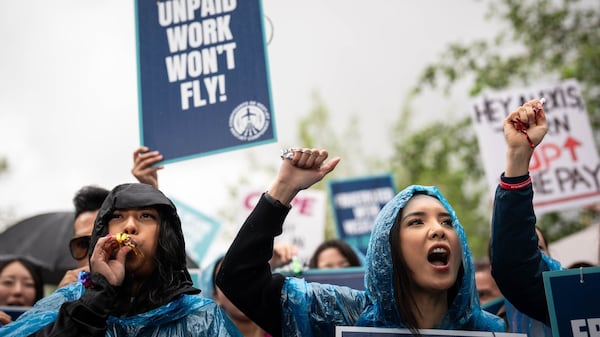
U.S. President Donald Trump has threatened to increase tariffs on all cars and trucks to 50 per cent next year following a collapse in trade talks with Canada. Conservative Leader Pierre Poilievre, meanwhile, is calling on Prime Minister Mark Carney to reconvene Parliament, while a recent report suggests around 87,000 Canadian jobs could be at risk from the ongoing trade war. Trump over the weekend also accused Canada of wanting “the benefits of being a State, without being one!!!” Follow along for the latest updates: Trump to increase auto tariffs to 50% U.S. President Donald Trump is firing back at Canada by announcing he will increase tariffs “on all Cars, Trucks, both large and small, Automotive Parts, and Steel” to 50 per cent on New Year’s Day. “Build in the U.S. and there are ZERO TARIFFS. Canada will be treated like a State no longer! On Trade, and in other ways, also, they are among the worst Nations in the World to deal with,” Trump said in a post on his Truth Social platform Monday. “They feel entitled, and yet, WE DON’T NEED CANADA, THEY NEED US! They do 95% of their business with the U.S., with us, the exact opposite! Thank you for your attention to this matter!” Michael Lee, CTVNews.ca lead morning producer ‘He can kiss my a**’: Ford lashes out at Trump over latest tariff threats Premier Doug Ford had harsh words for U.S. President Donald Trump who vowed on Monday to increase tariffs to 50 per cent on all Canadian cars, trucks, automotive parts, and steel on New Year’s Day. “He can kiss my a** as far as I’m concerned,” Ford told Newstalk 580 CFRA host Bill Carroll on Monday morning. “We are going to go at him full steam.” Ford said he is considering putting an export tariff on electricity to make the U.S. “feel the pain.” He urged all premiers across the province to “start jumping into the fight.” “I can’t be standing alone on this,” he said. “Every single province, or majority of them, deliver electricity down to the U.S. Alberta delivers 4.1 million barrels of oil down in the U.S.” Codi Wilson, CP24.com journalist, Read the full article here Greer: Fallout a ‘tempest in a teapot’ U.S. Trade Representative Jamieson Greer is downplaying the impact of the collapse of the trade talks with Canada. “I think this is a little bit of a tempest in a teapot,” Greer told reporters at the White House on Monday morning. “The tariffs went in place over the weekend, which we’ve warned about for a long time. They only cover about 5% of Canadian trade, only .06 percent of U.S. overall consumption.” Greer said he is preparing potential responses for Trump to Canada’s threat to retaliate dollar-for-dollar, but he declined to elaborate on the options. The Associated Press ‘Their word is not their bond:’ policy expert Canada was right to impose counter-tariffs after the U.S. threatened its national sovereignty during trade talks, says a public policy expert. The U.S. crossed the line by introducing issues that were “thrown in at the last minute,” including higher tariffs for trucks and content regulation for streaming devices, Drew Fagan, a professor at the Munk School of Global Affairs and Public Policy at the University of Toronto, told BNN Bloomberg. “That’s extraordinarily sensitive,” he said. With the U.S. breaking its word even after Canada made painful concessions to secure a deal, Fagan says Prime Minister Mark Carney may feel “he has no choice but to introduce counter-tariffs.” “Their word is not their bond,” he added. Fagan said he hopes the dispute freezes at the current level of tariffs and counter-tariffs instead of escalating into a tit-for-tat war because ultimately, both tariffs and counter-tariffs hurt Canada more than they hurt the U.S. “Let’s hope that politically, the Trump administration is hurt by this,” says Fagan. Anam Khan, BNNBloomberg.ca journalist CEO calls tariff-related drop in investments a ‘bad omen’ Tariffs have brought a drop in manufacturing investments, like plants, equipment and technology by about a third, compared to a year ago, Canadian Manufacturers & Exporters president and CEO Dennis Darby told CTV Your Morning. He calls it a “bad omen” for the future, for both Canada and the U.S. “What we’re seeing is not only slowdowns in production and probably even more slowdowns in production, but on top of that, companies aren’t investing for the future,” he said. “So, the two things together really lower the business confidence and that’s why it’s so important that we ultimately get back to the table with the U.S., because this affects the U.S. as well.” Elianna Lev, CTVNews.ca multi-platform writer Reconvene Parliament: Poilievre Just days after Prime Minister Mark Carney recalled Canadian negotiators from Washington and walked away from a trade deal with the U.S., federal Conservative Leader Pierre Poilievre is calling for Carney to reconvene Parliament over the decision. “We must put the national interest first,” wrote Poilievre in a letter to the prime minister. “The failure to secure a durable trade agreement, together with escalating tariffs, now threatens deeper economic pain on top of a decade of rising costs and zero economic growth in the Canadian economy,” the letter said. Jeremie Charron, CTV National News weekend correspondent U.S. anthem ‘booed’ at Vancouver soccer game Soccer fans are again voicing their disappointment over trade relations between the United States and Canada by booing the American national anthem. Jeers echoed through Vancouver’s BC Place ahead of a Major League Soccer game between the Whitecaps and FC Dallas on Saturday as singer Emma Currie launched into the opening notes of “The Star-Spangled Banner.” The song was similarly booed at Stade Saputo before CF Montreal hosted the L.A. Galaxy there earlier in the day. The audible protests came hours after Prime Minister Mark Carney suspended talks with the U.S. and recalled his negotiators back to Ottawa, prompting the Americans to impose 50 per cent tariffs on billions of dollars in Canadian exports. The Canadian Press Most affected provinces? Roughly 87,000 Canadian jobs could be at risk because of the United States’ new 50 per cent tariffs on Canadian goods, according to an analysis conducted by University of Calgary economics Prof. Trevor Tombe, who spent hours calculating Statistics Canada’s input-output numbers. His analysis estimates that approximately 52,000 jobs are directly at risk, while indirect effects on Canadian suppliers and service providers could put another 35,000 at risk. The hardest-hit provinces for job losses are Ontario (36,100), Quebec (18,300) and B.C. (11,200), while the industries that are set to have the highest number of job losses are machinery, electronics, plastics and rubber. “If we assume that these tariffs remain in place for some time, what it effectively means is that Americans will be purchasing fewer of the tariff items from Canadian producers – and that will mean less output in Canada and therefore less employment in those exporting firms,” said Tombe. Kamil Karamali, CTV National News weekend correspondent ‘In this together’: former Conservative deputy leader A former Conservative cabinet minister says she hopes Prime Minister Mark Carney will brief opposition members on the proposed trade deal and next steps. “Having other folks leak and talk to reporters, it’s not helpful,” Lisa Raitt, who is also a member of the advisory committee on Canada-U.S. economic relations, told CTV News Channel on Sunday. She added that she hopes Carney will set up a briefing in response to the Conservative leader’s request. “It’s openness that’s needed,” she said. “They want to know what’s in the deal that isn’t a deal and they want to know what programs are going to go forward for Canadians who are unfairly impacted by the 50 per cent tariff.” Devika Desai, CTVNews.ca journalist Release U.S. trade offer details: Conservatives Federal conservatives are calling on the government to release the full details of the trade offer from the United States that Canada rejected this week. In a letter to Trade Minister Dominic LeBlanc, Canada-U.S. relations critic Shuvaloy Majumdar said while his party supports the government’s decision to reject the deal, Parliament is in the dark on what was on the table. “If there was a draft text of any agreement that both governments have seen, please release it. The U.S. administration has seen it. Your government has seen it. Canadians deserve to see it,” Majumdar wrote. A spokesperson for the Bloc Québécois wouldn’t say whether they support the calls for the government to detail what the Americans were offering. But the party reiterated calls for a meeting between the “recognized” party leaders in the House of Commons to get a briefing on the situation. Green Party Leader Elizabeth May also said the party leaders should be briefed, but stopped short of demanding the trade details be made public. “I think we should have at least a Zoom call or Teams meeting as we used to do under the former prime minister to make sure that we are all updated,” May said. The Canadian Press ‘Job loss is inevitable’: B.C. Chamber of Commerce reacts to Trump tariffs The head of the B.C. Chamber of Commerce said job losses are “inevitable” and the future of small and medium businesses is in peril after U.S. President Donald Trump imposed punishing new tariffs on Canadian goods. “I think this is par for the course. We’re back on the merry-go-round. We did the math and counted 15 changes over the last 21 months. So, I think we just continue to live in this world of uncertainty,” Jen Riley, the chamber of commerce’s president and CEO, told CTV News Sunday. In Riley’s estimation, small and medium sized businesses in British Columbia are set to bear a disproportionate burden. “The exports we have to the United States are now going to have a 50 per cent tariff. And a lot of those that are going to get hit are small and medium businesses—and that level of tariffs is generally not something they can absorb,” Riley said. “So, we are very worried here in British Columbia that small and medium businesses are not going to be able to make it out of this.” Lisa Steacy, CTVNewsVancouver.ca journalist Read the full story here. Eastern Canadian premiers renew pleas to buy local Premiers in Eastern Canada are once again calling on residents to buy local as Canada squares off against the United States in an escalating trade war. “Every dollar spent on an Island or Canadian product supports the worker who made it, the farmer who grew it, the fisher who caught it, the producer who processed it and the business that put it on the shelf,” said Rob Lantz, premier of P.E.I., in a news release Sunday. The U.S. tariffs have hit businesses and workers in New Brunswick, Premier Susan Holt said in a statement on Saturday. “Now, more than ever, we need to double down on buying local and supporting New Brunswick businesses and workers.” The tariffs will affect about $7.7 billion of exports from Quebec, said Christine Frechette, the province’s premier. “To buy Quebec products is not an economic action, it is a nationalistic action. It’s an action of solidarity.” The Canadian Press Minnesota school faces $7K spike in price for mascot costume Parents at a Minnesota school say they are rushing to get a Trojan-themed mascot across the Canada-U.S. border by the end of the week to avoid paying a higher price due to the tariffs. Sarah Kallal said she and other community members had been inspired to procure a “professional-grade costume” for the school’s baseball team, in their hometown of Trojan The community had raised $14,000 for the costume. On Monday, Kallal said she got a call from the costume company that they had to pay an extra $7,000. “Honestly, I kind of thought the dream died,” Kallal said. “I’m not going to absorb that cost and I’m certainly not going to go back to our community to say, ‘Oh, by the way, can I get seven more thousand dollars?’” She was floored to learn that President Trump’s proposal to place a 50 per cent tariff on Canadian imports was to blame. She never expected that kind of economic policy to hit home so directly in a smaller community like New Prague.“ It brings awareness to how it’s not going to just affect corporations and government,” Kallal said. WCCO Trade war ‘devastating’ for Canada: Trump admin The Trump administration on Sunday warned that Canada would be “foolish” to think it could win a trade war with the United States. U.S. Transportation Secretary Sean Duffy told “Fox News Sunday” talk show that Prime Minister Carney will return to negotiations “very very quickly, because it’s going to be devastating for his country.” “We’re great trading partners, right? But Canada gets the benefit of trading with the U.S. way more than the U.S. gets the benefit of trading with Canada,” he said on the show. “To think that they’re going to go to war with Donald Trump and actually win that war with the U.S., I think it’s foolish on their part.” AFP U.S. customers ‘paying the full brunt’ President and Chief Executive Officer of the Aluminium Association of Canada Jean Simard expressed his concern for the future of the aluminium industry following the collapse of the trade talks between Canada and the United States. To put things into perspective, he said Canada produces 3.3 million tonnes of aluminium per year of which 90 per cent is exported. He added, “90 per cent of the exported product goes to the U.S.” Simard said in the U.S., “customers are paying the full brunt of the tariffs,” paying $1500 to $2000 more per ton than what Europe pays for the same amount. However, he noted not reaching a deal with the U.S. was not “a bad thing” as the talks had increasingly shifted toward a “U.S.-based advantage to the detriment of Canada.” Archie Niari, CTVNews.ca journalist U.S. after ‘fortress North America’ International trade lawyer at Mccarthy Tétrault Ljiljana Stanić says the collapse of the tariff talks with the U.S. was “unexpected”. “I think most people expected another extension was forthcoming,” she told CTV News Channel on Sunday. On the issue of U.S. asking Canada to match Washington’s tariffs on other countries Stanić said, “it seemed like the United States was trying to build fortress North America.” The trade lawyer said she believes “that was a lot to ask from Canada without having free trade with the United States.” Stanić also noted that “trade disputes are easy to start but difficult to contain,” and added that the situation is now at a tipping point where trade tensions between the two sides can quickly escalate. Archie Niari, CTVNews.ca journalist Trump: Canada wants benefits of statehood In his Truth Social Post, Trump also claimed that Canada has charged U.S. farmers “massive amounts of tariffs” for many years. Canada only imposes high tariffs on U.S. dairy exports if they exceed quota amounts. “In reality, however, the countries exporting products to Canada will not pay the high tariff because they will simply not export more than was negotiated in the trade agreement under which they have access,” states the Dairy Farmers of Canada, a national lobby representing Canadian dairy producers. Trump’s comments come after Prime Minister Carney delivered his own address on the trade dispute in which he said Canada is at economic “war” with the U.S. In Carney’s address, he said last-minute changes by the U.S. to the deal lead to a breakdown negotiations. Devika Desai, CTVNews.ca journalist We want to hear from you Are you worried about how tariffs might affect your work? Have trade disruptions already impacted your job? Share your story by emailing us at dotcom@bellmedia.ca with your name, general location and phone number in case we want to follow up. Your comments may be used in a CTV News story.