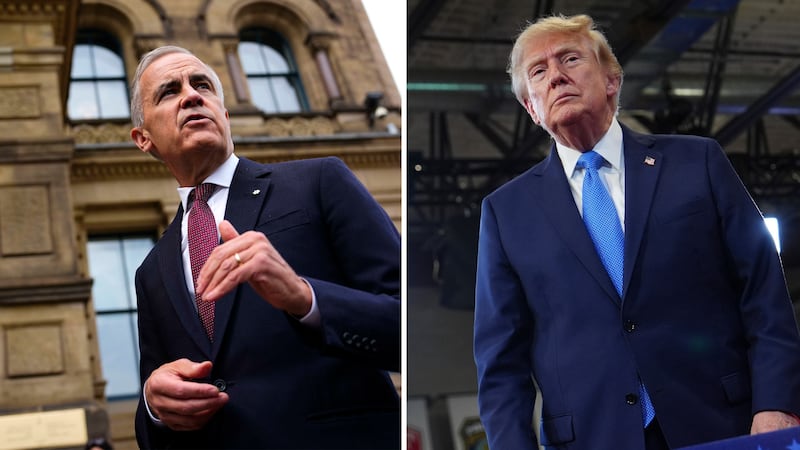
Trade negotiations are coming down to the wire. Just two days remain until U.S. President Donald Trump’s new wave of tariffs hit Canadian exports. Trump has threatened 50 per cent tariffs on a variety of goods from cement to hockey sticks. Those levies will come into force on Aug. 19, unless negotiators can talk their way out of it. Follow along for key updates. Canada ‘used as a punching bag’ Shuvaloy Majumdar, the Conservative critic for Canada-U.S. relations, said Ottawa’s political class is united across party lines when it comes to securing a trade deal with an “often unpredictable administration in Washington.” “We have grown tired of seeing our country used as a punching bag. Yet we share a common hope that Prime Minister Carney will deliver a genuine win at the negotiating table,” reads a statement released Monday morning. “Our negotiators have our full support in securing an agreement that lifts the tariffs and duties now weighing on our steel, aluminum, lumber and automotive industries,” which he said affects the livelihoods of 2.6 million Canadians. Luca Caruso-Moro, CTVNews.ca journalist The ‘gap’ between Canada and U.S. There remains a “gap” between Canadian and U.S. negotiators, according to Flavio Volpe, a member of Team Canada’s group of insider advisers. He predicted talks may continue to the deadline later this week and noted high-level meetings that took place on Sunday are “not typical.” Volpe is also president of the Automotive Parts Manufacturers’ Association. He said Canada’s auto sector could see real losses in the long term if Canada cannot secure an auto tariff rate below industry-wide six per cent profit margins. Under the current tariff schedule, North American auto manufacturers are absorbing an effective tariff rate of at least 12.5 per cent, Volpe said. But, at “10, 15 per cent, especially if it’s baked in, especially if it’s long term, those companies will give up,” he told CTV News Channel. “You won’t see them close doors tomorrow, but you’ll see a similar situation to what we see in Brampton right now.” Last week, the prominent union Unifor said Stellantis is considering closing and selling its Brampton, Ont., assembly plant, which has been idled since 2023. Luca Caruso-Moro, CTVNews.ca journalist U.S. senator: Canada’s ‘wake-up call’ U.S. Sen. Chuck Grassley of Iowa said Trump’s threat should serve as a “wake-up call to Canada to make some changes.” “I think the president is probably using them as a lever,” Grassley said Friday in an interview with The Canadian Press at the Iowa State Fair in Des Moines. While the senior Republican has been a key backer of Trump’s agenda on Capitol Hill, he also has continued to voice his support for free trade despite the president’s growing tariff regimen. Grassley said there’s nothing wrong with Canada and the United States having tough negotiations, but added, “These negotiations cannot be used as a way of destroying” the trilateral trade agreement known as CUSMA. The Canadian Press. Read the full story here. Greer’s birthday meeting Canada-U.S. Trade Minister Dominic LeBlanc and U.S. Trade Representative Jamieson Greer met on Sunday, days ahead of the latest tariff threat from the American president. LeBlanc and Canada’s chief trade negotiator, Janice Charette, spent the weekend in Washington, D.C., after meetings last week. A short statement on Sunday evening from a spokesperson for LeBlanc said the one-hour meeting, which was virtual, involved LeBlanc, Greer and Charette and was “constructive.” “They took stock of the work that has been done by their respective negotiating teams, and discussions are continuing,” the spokesperson said. The meeting took place virtually because Sunday was Greer’s birthday. It marked the fifth meeting between the two since Trump’s tariff threat. The Canadian Press Que. premier: Don’t drop supply management Quebec Premier Christine Fréchette met with representatives from the province’s agricultural sector Friday, wrapping up two days of emergency meetings as the government prepares for potential impacts of U.S. tariffs. Fréchette said the federal government must uphold Canada’s supply management system, which controls the production and pricing of dairy, poultry and eggs. She said Quebec’s dairy sector could be most affected by tariffs. Quebec accounts for 37 per cent of Canada’s dairy production, with nearly 4,000 farms and tens of thousands of jobs in the industry, Fréchette said. “We need to make sure that the federal government will not put forward the idea of modifying the supply management for the dairy sector,” Fréchette said Friday. “Quebec has been, so far, the most impacted province when it comes to the impact of the tariffs. Many sectors have lost a lot of jobs, thousands of jobs, and therefore, it is even more important to preserve the supply management mechanism for the agriculture sector.” Robin Della Corte, CTVNewsMontreal.ca digital reporter