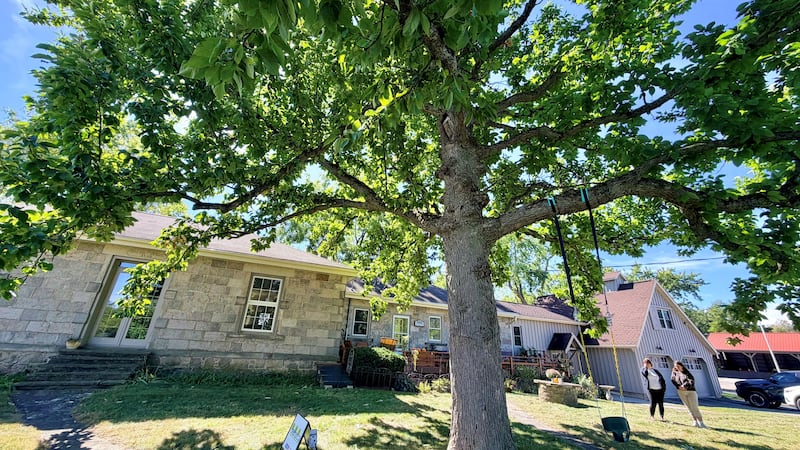
A partial closure at a popular river valley viewpoint was enacted because of a landslide, the City of Edmonton has confirmed. The city announced on Wednesday that part of the viewing platform at Keillor Point, informally known as The End of the World, had been closed off because of deterioration of the slope underneath from record rainfall over the summer. On Friday, a city official told CTV News Edmonton that six pillars that previously stood beyond the viewing platform had been washed away in a landslide in June. Continued monitoring showed further deterioration at the site after the slide. The platform is supported by remnants of a pile wall originally installed to stabilise a portion of Keillor Road in the 1980s and 1990s. Keillor Road was permanently closed to traffic in 1995 due to erosion. “There used to be six pillars, and those have slid down,” Braeden Holmstrom, the city’s supervisor for river valley parks, told CTV News Edmonton on Friday. “Those used to be connected to the ones that we’re standing on right now.” Holmstrom says trails are not allowed in the Keillor Point portion of the river valley because it’s an active landslide area even in years with less rainfall. “We don’t know when it will happen. One day overnight, the concrete pillars can fall and we don’t know about it until they do,” he said. The End of the World was a popular but unsanctioned viewpoint for Edmontonians for years until the city constructed the current viewpoint in 2018. “This lookout that we are on right now just used to be a dirt hill, and the pillars that this was built on top of were just places that people would go and sit,” Holmstrom said. “It was very dangerous. There were lots of injuries, so we turned it into this lookout to give people an opportunity to enjoy the view, but make it a little bit safer.” The city has been conducting regular geotechnical inspections and monitoring in the area for years because of the landslide danger, but Holmstrom says last winter’s snowfall and record rainfalls over the summer accelerated the problem. “We knew that [the pillars] fell, but then as we saw more erosion happening, that was when we recognised that we needed to put up the fencing.” The city uses a combination of technology and human reporting to track slide activity. “Our geotechnical teams and our engineers have monitoring stations throughout the river valley in areas that we know that there are landslides or active slumping or active zones, and those monitors can tell us that there’s shifting movement,” Holmstrom said. “We also rely on the public letting us know that things are happening within the park space, but we also have teams of staff who come to our lookouts and let us know what the consistent condition of them are.” Erosion is a problem that is not limited to Keillor Point. “This year we’ve seen some trails be impacted really on every side of the city. Here on the west side of the river valley, there’s been trails in Whitemud Park and the Whitemud Ravine that have seen some slumping,” Holmstrom said. “On the east side of the city over in Capilano, we have a trail closure on some of our granular trails.” A man who studies erosion and ground movement says Edmonton’s river valley is always shifting. Renato Macciotta is a professor at the Geotechnical Centre at the Civil Engineering Department at the University of Alberta. “Most of the slopes, if not all, are moving in some way or another. It’s just a natural balance of nature between erosional processes and the stability of our slopes,” he told CTV News Edmonton on Friday. “When we talk about in particular the North Saskatchewan riverbanks, they are no stranger to these type of landsliding events. As a matter of fact, the North Saskatchewan River has a lengthy history of landslide activity that has made it to several research publications.” One notable example of erosion activity in the river valley happened in October 1999 when one house in Riverbend slid into the valley and others were left hanging over the edge. While some years see less activity than others, Macciotta says 2026 has been particularly busy. “It’s been a very active year to say the least, and not just here in the city, but province wide,” he said. “I’d say we’ve had several occasions where we had already been studying them in terms of landslide events, rockfall events, and our measurements this year have indicated that the frequency of them and the magnitude of them have definitely increased.” Work is still underway to determine how to proceed with the situation at Keillor Point. “This area remains safe,” Holmstrom said of the unbarricaded portion of the viewing platform. “We put up the barricades behind me and the fencing just to make sure that people are aware that there is a safety concern in the area, and that is an area that we would like them to stay away from. But they can still come to this site.” “This will remain up throughout the winter season and into next year, and then once we have a plan to move forward to remediate or make the area safe, then we can adjust accordingly.” With files from CTV News Edmonton’s Nicole Weisberg