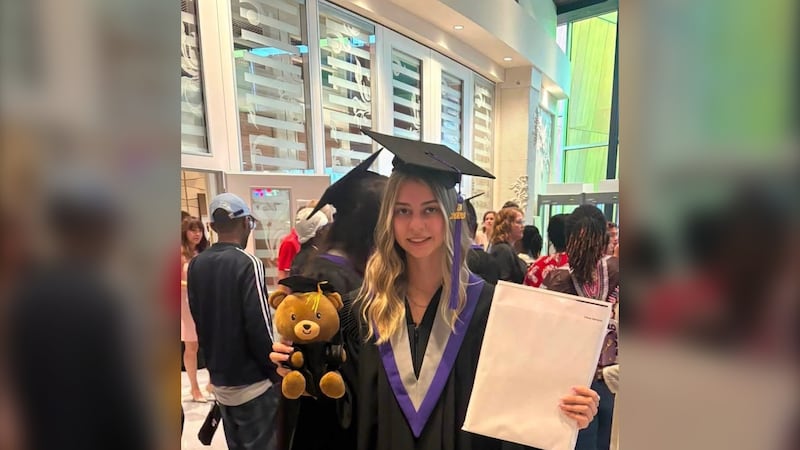
Roula Bou Chahla says every day is both a dream and a nightmare. After trying to become a mother for the last 18 years, she says she had almost given up hope when suddenly, little five-month-old Liana appeared in her life through an international adoption service in Lebanon. “I adore her. I love her. I adore her,” Bou Chahla said, beaming. “This is the most beautiful thing I’ve ever done in my life ... I’ll do anything for her. What else could you want? I would give my life for her.” The Montrealer calls her little girl a “ray of sunshine,” but the joyous occasion quickly turned to one of anxiety. Mother and daughter — now 22 months old — are currently stuck in war-torn Lebanon because the Quebec government says it did not approve the adoption ahead of time. “We may never be able to return home because our life is treated like just papers on a desk,” she tells CTV News. “The government forgets that behind this fight there is a little human being.” For her husband, Jean Abou Ghannam, the separation has meant watching his daughter grow up from thousands of kilometres away. “She took her first steps without me being by her side. She’s speaking right now and she’s even saying my name,” he said. “And I’m here, dying. It’s killing me.” He adds that time has not been on their side. “We are condemned not to have a child here in Quebec,” he said. “We need this. We cannot wait. We are both 51 years old, so it’s now or never.” The couple had been on the province’s adoption waiting list for 13 years. After being told that they could be waiting another 12 to 20 years to hold a child in her arms, Bou Chahla says she turned to the international adoption service, the Secrétariat aux services internationaux à l’enfant (SASIE). “When a system shuts its doors on you and imposes delays and delays and delays while a child is waiting, what do you do?” she asked. “I would have loved so much to adopt from Quebec without having to go through all the stress, but Quebec wouldn’t let me do so.” Bou Chahla, a teacher, says a SASIE agent explained the couple would have several forms to fill out, including one called ‘International adoption without the involvement of accredited agencies,’ in cooperation with a non-governmental organization (NGO) in Lebanon. A few weeks later, she says she received a refusal from the government, with a request for more information. “I said, ‘OK, maybe they need an official document from the person in charge of the adoption in Lebanon,’” she said. “I called the Justice Department in Lebanon to ask if I could have proof that I’m not trafficking a person, and they said, ‘Yes, of course.’” At that moment, Bou Chahla says she and her husband were juggling between waiting for the Quebec government’s updated response and potentially losing their date to meet with a Lebanese judge to evaluate their potential as parents. Bou Chahla says the couple chose to get on the plane. After meeting their daughter for the first time, the answer finally came: the government would not recognize the adoption. “You feel helpless, you feel discouraged, you feel shattered, you feel exhausted,” she said. “It’s a project that’s close to our hearts. We absolutely want our family. We absolutely want to have a baby, and if I’d been able to have my own baby, I wouldn’t have gone through this whole nightmare.” Following the news, Abou Ghannam was forced to return to Canada, but Bou Chahla has been in Lebanon with Liana for the last 18 months, desperate for help. “I’m responsible for this baby here in my arms. I’m responsible for her safety,” she said. “When I held her in my arms for the very first time, I made her the promise of my life. I promised to provide her with safety and stability. I told her about her room in Laval, which was waiting for her, and about her father, who was waiting for her too.” Bou Chahla says she feels guilty about not being able to “keep” her promise to Liana. “She needs her father and her mother, and to live in a place that’s her own,” she said. “We were laying the groundwork for our family because we’d been dreaming of her for 18 years.” Abou Ghannam insists the couple understands the need for safeguards around international adoptions but believes the system has failed his family. “We choose Quebec because we love Quebec. We love it for its value, including for its family advantages,” he said. “But now, the only thing I have ever asked of this province — help for us to build a family — and it says no to us adopting.” Bou Chahla adds if she is unable to bring her daughter home to Quebec, the couple will have no choice but to consider other options — another province or even country. “We are going to lose everything: our home, our friends, our community, the teaching position that I love so much,” said Bou Chahla tearfully. “I feel broken. I feel as though Quebec is punishing me simply because I wanted to save an innocent child and offer her the dignity she deserves.” She argues the situation in Lebanon is unsafe, and the sound of drones flying overhead often wakes Liana up at night. “I fear for my life. I fear for my little girl’s life,” she said. “We can hear the drones. She hears the humming. She hears the noise.” Bou Chahla says she refuses to consider the possibility that the family may have to stay in Lebanon permanently if the adoption is not recognized. “She was in my heart long before she came into my life. I will fight for her until my last breath,” she said emotionally. “I will never give up, never. If you see me smiling sometimes, know that deep down inside, I live in constant anxiety. Liana should be safe, protected, and not growing up in the middle of a war zone. She had the right to grow up in a safe country, where her parents are.” Strict legal framework According to the Quebec Health Ministry (MSSS), which oversees procedures, international adoptions are subject to the province’s laws, as well as those of the child’s country of origin and international conventions. “The legal framework currently in force in Quebec does not permit private adoption or the recognition of a domestic or international adoption of a child without prior authorization,” it tells CTV News. That means an international adoption cannot be recognized “if certain essential conditions are not met,” including “the compliance of the adoption process, the validity of the consents obtained, adherence to cooperation mechanisms between the competent authorities, the required documentation, or the safeguards ensuring that the adoption was carried out in the child’s best interests and with due regard for their rights.” The ministry explains that Quebec is obliged to comply with the Hague Adoption Convention, an international agreement that protects children during the adoption process, stops illegal adoptions that may involve human trafficking or kidnapping, and more. “The MSSS’s mandate includes ensuring compliance and authorizing each stage of an adoption process until the child’s arrival in Quebec. The MSSS’s mandate is governed by a strict legal framework,” it insists. “It is subject not only to provincial adoption regulations but also to federal regulations concerning the immigration of internationally adopted children. The authority has no discretionary power to grant exceptions.” When talking specifically about Liana, the ministry notes that it “cannot comment on individual cases or the reasons that may have led to a decision in a particular adoption case.” “The fact that an adoption is legally recognized in another country does not automatically mean that it will be recognized in Quebec,” said the ministry. “The Quebec authorities must ensure that the requirements set out in their legislative framework and the applicable international standards have also been met.” All the same, the ministry acknowledges that “adoption processes often bring great hope to families and that certain decisions can be a source of disappointment and confusion.”