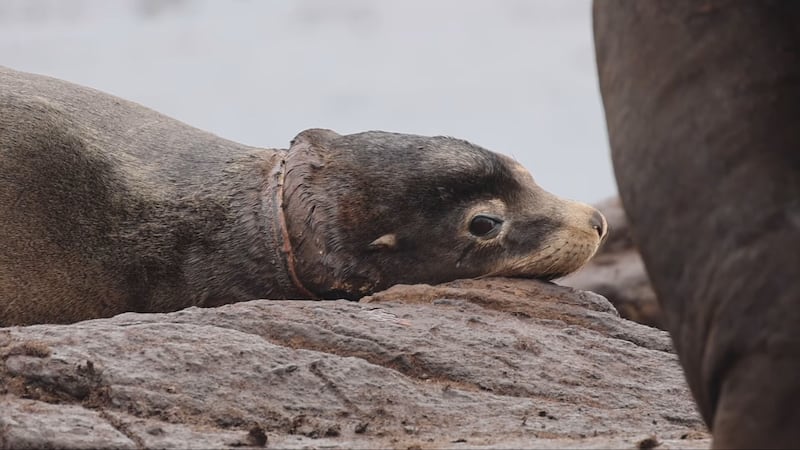
A sea lion that spent about a year with fishing gear embedded in its neck has finally been freed, following a challenging rescue at Race Rocks Ecological Reserve off southern Vancouver Island. The Vancouver Aquarium Marine Mammal Rescue Society returned to the remote reserve on Oct. 6, and successfully removed a thick rubber band used in crab traps, which had been cutting into the animal’s neck. Dr. Martin Haulena, the society’s executive director and head veterinarian, says the rescue was a success, but the animal’s ordeal highlights the devastating impact marine debris can have on wildlife. “It’s a very painful, nasty, long, prolonged duration of suffering before these animals actually die,” Haulena said. The team first received reports of the sea lion in October 2025, after eco-guardians at the Race Rocks lighthouse spotted the injured animal. But by the time rescuers could get there a few days later, it had disappeared. “We’ve been tracking this guy for a while,” Haulena said. Sea lions can travel considerable distances, even when badly injured, making it difficult for rescuers to find them again. Haulena says it is not unusual for an entangled animal to survive for months while the material continues to cut into its body. In this case, the team was able to intervene before the band caused serious damage to the sea lion’s blood vessels, airway or nerves. “Once that is removed, and as long as it hasn’t caused any serious damage, animals can recover really, really well,” Haulena said. The rescue required careful coordination between the marine mammal team, the Department of Fisheries and Oceans and the eco-guardians who monitor the reserve. Weather, visibility, currents and boat access all had to line up before the team could safely attempt the operation. “The actual rescue was pretty routine, if I dare say that,” Haulena said. Getting the team onto the island, however, proved to be the trickiest part. The currents were particularly strong, forcing boat operators to approach from the opposite side of the island from the usual landing spot. Once the team reached the animal, Haulena was able to administer a tranquilizer dart. The sea lion responded well, allowing rescuers to remove the embedded rubber band. “The band came off very easily,” he said. The recovery has also been encouraging. Eco-guardians have continued seeing the sea lion around Race Rocks, giving the team opportunities to follow its progress. “Very successful. Very happy,” Haulena said. But while this rescue had a positive outcome, he says the number of entangled marine mammals far exceeds what rescue teams can reach. Haulena estimates that as many as 400 California and Steller sea lions in British Columbia may be affected by marine debris at any given time. The society typically manages to disentangle six to 10 animals a year, with each mission dependent on a narrow window of suitable conditions. “We try and get out as much as we can,” Haulena said. “But there’s a lot of animals affected.” He says the work also requires a large team. A typical operation involves at least five people from the rescue society, including a veterinarian and veterinary technicians, alongside boat operators and other support staff. The Race Rocks mission also offered an opportunity to train veterinarians from the United States and share the specialized skills needed to disentangle marine mammals. Haulena says that kind of collaboration is essential to expanding the number of people capable of carrying out these rescues. He also stressed that the society depends heavily on public donations to continue its work across British Columbia. For the sea lion found at Race Rocks, the removal of the fishing gear has given it a chance to recover. For Haulena and his team, it is a reminder of why they keep going back out, despite the challenges of working in remote, unpredictable conditions.