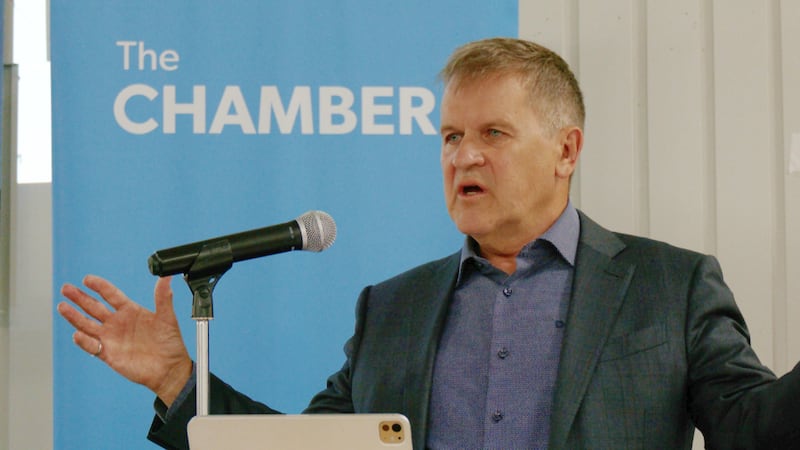
Representatives for Waterloo Region’s rural communities are raising concerns over how tax dollars will be spent for ION light rail expansions. The region’s Sustainability, Infrastructure and Development Committee received a report examining the Initial Business Case for Stage 2 Rapid Transit to Cambridge on Tuesday. The report suggested expanding the rapid transit line into Cambridge could help boost the city’s economy, similar to how Kitchener and Waterloo saw growth during the first stage of the ION project. “This project is transformational,” Doug Spooner, Waterloo Region’s acting transit commissioner, said during the meeting. “So much of what we do around this horseshoe is incremental – trying to make people’s lives better one quick change at a time. This is one of the few tools that we have to make transformational change in how our community looks and how we move through it.” “We’re at a crossroads,” he continued. “All of us have to decide what kind of community we want to live in and how we want it to evolve.” But not everyone was on board for the ride staff were envisioning. “Is this area rated and are the townships paying for the ION?” Wilmot Mayor Natasha Salonen asked. Area rating is a practice by which municipalities can adjust tax rates for residents based on the level of service they receive where they live. Area rating would ensure people who receive a higher level of service, such as people living in areas where the ION runs, pay more taxes, rather than sharing the tax equally among all residents. “That’s not how we fund our capital programs,” Wayne Steffler, the region’s Commissioner of Corporate Services, said. “We don’t use area rating for all the various elements like that. It’s done based on the analysis that’s done to calculate what’s required in those reserves and then we go through a capital budgeting process.” “This to me is completely, directly related to the ION but this omission through how we do our reserves and our capital funding - I’m not saying that’s wrong, but I’m saying that’s now contrary to what I have been informed of throughout this whole process - that the townships will not be paying for this. So how are we going to make this square round?” Salonen asked. Spooner said he did not have an answer immediately during the meeting, but he was planning to gather more information to answer Salonen’s concerns regarding the capital funding stage. “For clarification: will the townships be paying for part of the LRT?” Mayor of North Dumfries Sue Foxton reiterated. “Today, again, how it works is the operations [of the LRT] are area rated – I need to check back on the capital program just to make sure there aren’t planning activities that are funded out of our shared taxbase,” Spooner said. Woolwich Mayor Sandy Shantz said she supports the expansion of the ION into Cambridge, but she believes the projected economic boost, and the taxes that come with increased business along the ION line, won’t reach the townships. “The townships aren’t benefiting from the taxes that are generated there,” she said. “The cities are. The region is. We benefit as a region, but the cities are benefiting from that tax income. The townships don’t.” “When people ask me, ‘Do the townships pay for LRT?’ We don’t benefit from LRT the same way the cities do, and I do believe that we pay for it in the sense that dollars that are going into the LRT are not going into the townships,” Shantz continued. “We need to really consider all the pieces and how can we be fair to all areas of the township, economically, environmentally and as we transport people from place to place,” Shantz said. “I struggle with the notion of dividing our region into pieces and talking about who’s benefiting,” Spooner responded. “When the tax uplift happened from LRT Stage One, taking a single-storey lowrise to a tower where we’re obviously generating more taxes, that goes into a general fund for the programs that I deliver.” He noted money from that fund go toward road maintenance and development throughout the region, including in the townships. “We talk a lot about area rating and how some people pay for some services and other people don’t pay, when really if we wanted a complete picture of mobility and area rating, there’s a big conversation to be had in the area of roads versus transit versus all the mobility services we provide,” Spooner said. “I would disagree that we haven’t provided that economic benefit back to the townships and we’re actually providing more by having not area rated that full mobility picture.” A staff recommendation on the next phase is expected to be presented to council in November. In the meantime, the region will be collecting feedback from residents through an online survey until Oct. 24. A series of public information sessions are also planned. The next one is coming up on Sept. 16 at Sportsworld Arena in Kitchener from 4:30 p.m. until 7 p.m., followed by another event at Cambridge’s Old Post Office on Sept. 23 from 4:30 p.m. until 7 p.m.