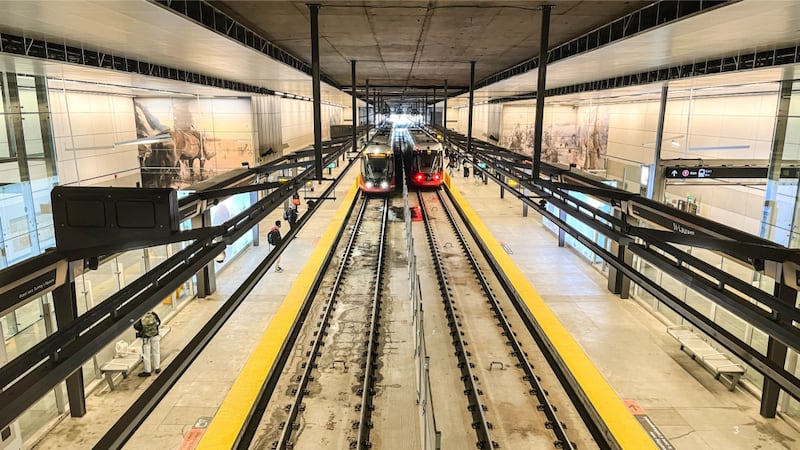
The City of Montreal is urging residents to stay home, eliminate non-essential travel and use public transit if necessary due to the impact of Wednesday’s freezing rain. During a press conference Tuesday, officials stressed that the city is ready and has mobilized crews and services in anticipation of an ice storm expected to bring 20 to 30 millimetres of freezing rain starting early Wednesday morning, which could lead to power outages. More coverage of the ice storm: Crews deployed across the island The deputy leader of the City of Montreal’s executive committee, Alexandre Devaux-Guizani, said crews were already working Tuesday, clearing catch basins to prevent water accumulation. He added that about 1,000 city workers will be spreading salt and abrasives on sidewalks and streets across the island throughout the day until the precipitation ends. Montreal has 10,000 kilometres of streets and sidewalks, and workers will focus on streets with slopes, which will be salted every 30 minutes, arterial roads every three hours, and local streets every eight hours. “But let’s be honest — tomorrow it’s going to be slippery. We strongly encourage people: if you need groceries, do it today. If you must go out tomorrow, wear a pair of ice cleats and take precautions. The city is ready to act across all 19 boroughs,” Devaux-Guizani said Tuesday. The city is also asking employers to accommodate employees by allowing remote work to reduce essential travel to a minimum. Civil security and emergency plans The head of Security and Prevention at the City of Montreal, Dimitrios Jim Beis, said the message was also meant to reassure Montrealers, adding that the most difficult part of preparing is not knowing whether it will be rain or freezing rain. “Tomorrow morning, there will be more meetings. We’re monitoring the situation very closely. What I can tell you is that civil security is mobilized. If we need to activate emergency measures, we’re ready,” Beis said. “We’re in communication with the boroughs, the Canadian Red Cross, and of course with the STM, Montreal police, the Montreal fire department, and all services.” Beis explained that the weather will determine how services are deployed. He noted that boroughs have also made preparations for the storm and have their own intervention plans in place. If emergency measures are activated, the city will centralize efforts. “The boroughs already know their roles and what they will do if measures are triggered.” Beis also said that boroughs will have shelters on standby in case of emergencies, including power failures. “There will also be specialized teams on the ground to remove branches and secure the roads. That will happen gradually, depending on the situation,” he said. He acknowledged that no matter the weather on Wednesday, it will be challenging. Transit plans and precautions The chair of the Société de transport de Montréal (STM) board, Aref Salem, said he has been in contact with the transit agency, which also has a plan in place. “It could be fairly serious. I can reassure Montrealers about our readiness. We’ll certainly adapt to whatever comes,” Salem said. He urged people to plan ahead and allow extra time to get where they are going in case bus routes are delayed because of the weather. He confirmed that STM service remains the same for now. Pulsar, the operator of Montreal’s light-rail system, the Réseau express métropolitain (REM), said preventative measures are being implemented to ensure the safety and reliability of service. The REM service will end early, with the last departure from Central Station at 11 p.m. in each direction, to allow for the spreading of de-icing products. “This closing time takes into account both the end of the Canadiens game at the Bell Centre and the expected arrival of freezing rain during the night. The contingency plan will be implemented to ensure continuity of service,” the company said. The operator said trains without passengers will run throughout the night from Tuesday to Wednesday to limit ice accumulation on the catenary, the network’s power supply line. “Train frequency will be adjusted, with trains running every five minutes across the entire network throughout the day on Wednesday. This measure aims to prevent excessive ice buildup on the overhead lines and ensure service reliability,” Pulsar said. The operator will also be using enhanced techniques to combat ice on the network, including the ability to adjust electrical management to increase temperature and reduce ice formation. It warned, however, that effectiveness will depend on weather conditions. Montreal stormwatch