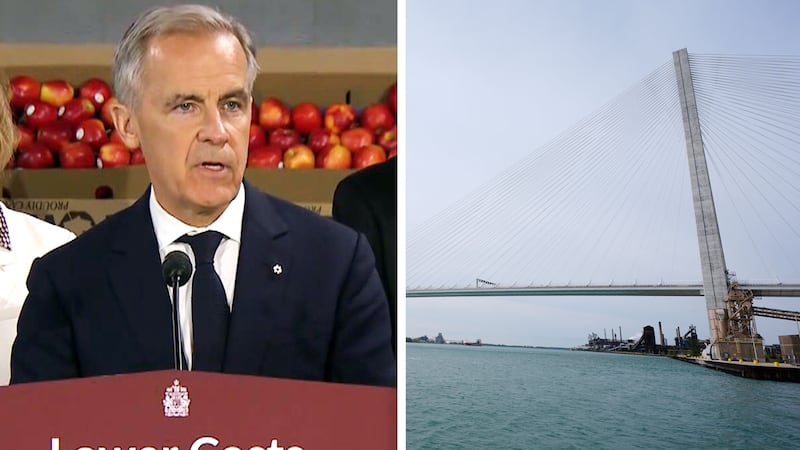
Prime Minister Mark Carney says Canada will do “whatever it takes to defend and support our families, our workers and our businesses,” amid an ongoing trade war with the United States. Carney is meeting with Canada’s premiers in Charlottetown on Thursday, on the final day of the provincial and territorial leaders’ annual gathering, as the topic of U.S. President Donald Trump’s threats of stacked tariffs on Canadian goods continue to loom large. “We are in a stronger position than we were when this trade war started 18 months ago,” Carney said. “We’re in a stronger position because of the determination of Canadians themselves, and I will say this, because of the focus of the premiers around this table.” The leaders of Canada’s provinces and territories spent the lion’s share of Wednesday in closed-door discussions — covering a range of topics, according to a statement released afterwards — and say the focus Thursday is on hearing Ottawa’s negotiation plan when it comes to Trump. On Monday, Trump signed an executive order to impose a new 50 per cent tariff on some Canadian goods, including wine, hockey sticks and cement, for what his administration is characterizing as discriminatory trade policies. U.S. Trade Representative Jamieson Greer, meanwhile, was questioned by U.S. senators on Wednesday. Here’s everything you need to know: ‘Full range’ of retaliation options: Carney Asked to expand on his comments from Thursday morning that Canada will do “whatever it takes” in the face of Trump’s latest threats, Carney pointed to supports for Canadians and tariff-affected sectors. He also said when it comes to retaliation if and when the new tariffs come into effect next month, “there’s a full range of things that we can do in that regard.” “We don’t need to respond in advance,” he said. “In fact, I think it would be counterproductive at this stage to respond in advance.” “It’s important to know what your options are, to have worked it through, to have shared, as it affects certain provinces or they have perspectives directly, and be united in that response,” he added. “And I would say, and premiers obviously speak for themselves, we are united in direction and objective and purpose and seriousness about the response.” Spencer Van Dyk, Journalist, CTVNews.ca Lantz says premiers working to remove internal trade barriers P.E.I. Premier Rob Lantz said premiers are committed to removing internal trade barriers and expanding that model “more consistently across the country,” a promise Carney made nearly a year and a half ago and on which provincial and territorial leaders have largely failed to deliver. Despite the MOU signed last week to remove major barriers to interprovincial alcohol sales, barriers on certain goods including dairy, some food products, construction materials and other supply-managed products still exist. “It shouldn’t be more difficult to do trade between our provinces than it is to do trade between countries. So, in the last 18 months, we’ve made significant progress,” Lantz said. “It’ll represent big changes for all Canadians and for beverage producers,” he added. Speaking to reporters following his meeting with premiers, and in a joint statement afterwards, Carney said his Internal Trade Committee will work toward an agreement-in-principle over the summer to help the provinces eliminate internal barriers to labour mobility. Neither Carney nor Lantz provided a deadline by which the provinces will remove all internal trade barriers. Kayla Thompson & Spencer Van Dyk, Journalists, CTVNews.ca ‘Everything is on the table’ in negotiations: Carney Speaking to reporters following his four-hour meeting with Canada’s premiers on Thursday, Carney said “everything is on the table” when it comes to negotiations with the United States, if there’s no agreement before the new slate of tariffs come into effect.“ Everything is on the table, depending on the outcome of the negotiations, yes,” he said. In his opening remarks to reporters following the meeting, Carney also said his talks with the provincial and territorial leaders is an example of “the federation working as it should,” citing the national unity in the face of Trump’s latest threats. “Let’s be clear about how Canada is responding,” he said. “Yes, we are intensifying our negotiations with the United States in pursuit of a comprehensive agreement that addresses all tariff-related sectors. Spencer Van Dyk, Journalist, CTVNews.ca Tariffs both pressure tactic, opportunity: PM Carney When asked if the 30-day deadline for trade talks is a meaningful opportunity to approach some sort of end game with the United States, or just another pressure tactic from the Trump administration, Carney said “it’s both.” The prime minister shared his two observations on the deadline: “One, we all recognize that the most important thing we can do is to continue to build this economy strong and unite this economy. That’s job one” he said, adding that it’s an immediate benefit for Canadians, and something “we can control.” “The second is to be united with respect to our trades, our strategy, our negotiating strategy, and our objectives. And part of that unity is recognizing that there isn’t a series of little trade issues: they’re broad trade issues. All of them have to be part of the agreement.” Kayla Thompson, Journalist, CTVNews.ca ‘I should have been clearer’: Carney on Gordie Howe bridge deal After days of conflicting messaging surrounding the Gordie Howe International Bridge deal, Prime Minister Mark Carney admits he could have better explained what was agreed upon between Canada and the U.S. “I should have been clearer,” Carney said when asked directly by CTV News if he lied about the agreement at a press conference in Charlottetown on Thursday. Carney was referencing his response in an interview with CTV Calgary on July 12 in which he said money from the bridge would only be shared with the U.S. after debt costs were recovered. But official details of the deal published late Tuesday – after days of political pressure – does not explicitly mention interest costs or debt payments related to the bridge, meaning Canada will repay its debt but only after splitting net revenue with the U.S. over those first 15 years. Stephanie Ha, Journalist, CTVNews.ca, Read the full article here ‘Sticking together’ critical for Canada’s future: Goodale Canada-U.S. Trade Relations Council member Ralph Goodale told CTV News Channel Thursday that the premiers seem to have different tactics and approaches in responding to the U.S. However, they are united over the “core question” of pulling together and doing what they can against Washington. “The prime minister has been remarkably successful so far in pulling things together,” Goodale said. He added that the best thing to do before the new tariffs start is to make the best effort to get a deal. “We have to make our very best case that it would be sheer lunacy on the part of the United States to shoot themselves in the foot” by making CUSMA ineffective, he said. Goodale also said Canada must be prepared for any action in case the two sides fail to reach a deal within the next month. “We can’t rule anything out when we are dealing with Donald Trump.”Goodale added that despite their differences, the premiers say they will “stick together,” which he said will be critical for Canada’s future. Archie Niari, Journalist, CTV News Expert predicts PM Carney and premiers may clash Some premiers may be frustrated by Prime Minister Mark Carney’s non-retaliative approach towards Trump over his tariffs, one expert says. “He just kind of takes it in his stride and keeps going,” Lori Turnbull, political analyst told CTV News Channel on Thursday. “I don’t know if that is going to be what the premiers want to hear. I think they want to see a clear plan.” She noted that the premiers appear “united” over seeing Trump as “a kind of common opponent.” “But they are experiencing the effects of the tariff war differently,” she added. At the meeting Thursday, premiers will want to know how the federal government is going to “help them” she said.“They’re connecting (the tariffs) back to things they want to do for their constituents,” she said. “They will want to keep focus on domestic concerns like health care, affordability, cost of living, the housing crisis, and get answers ... about what’s going to happen.” Devika Desai, Journalist, CTVNews.ca Trump’s tariff move ‘intended to put pressure on Canada’: lawyer The Trump administration’s plan to hit Canada with new 50 per cent tariffs is “clearly a move intended to put pressure on Canada,” an international trade lawyer says. “It’s a difficult position (for Canada) where the U.S. clearly wants concessions on specific items, but is not as interested in renegotiating a full (CUSMA) agreement,” Ljiljana Stanić, a lawyer at Mccarthy Tétrault, told CTV News Channel on Thursday. In order for Canada to reach an agreement with the U.S. before the 30-day window expires, Stanić says Prime Minister Mark Carney may have to make further compromises, this time on long-term irritants, including dairy and lumber. “The prime minister is running into some risk here,” she says, referring to Greer’s warning last month that the U.S. will not give Canada negotiation credits on deals made outside formal CUSMA talks. “So there’s a significant risk that if we make one-on-one concessions here and there, that that actually won’t necessarily help a deal if it’s not done within the deal framework,” Stanić adds. Kayla Thompson, Journalist, CTVNews.ca Tariffs causing “consternation” among U.S. lawmakers: experts Some American lawmakers are as concerned as Canadians with Trump’s latest threats of tariffs, one political expert says.“ Many of those lawmakers simply weren’t buying it, including members of the president’s own party,” Eric Ham, CTV News political analyst told CTV News Channel on Thursday, of trade czar Jamieson Greer’s testimony the day before wherein he defended the tariffs. “It’s causing increasing consternation ... we’re now seeing many lawmakers have to figure out how they too can actually move forward.” Politicians have described the tariffs as “chaotic” and “unpredictable,” he added. This could put more pressure to get a CUSMA deal renewed as lawmakers expect that the tariffs will compound the problem of rising living costs.“ This is going to put President Donald Trump in a very difficult position,” Ham said. Devika Desai, Journalist CTVNews.ca ‘Let’s get this done’: Lantz In their joint communique issued at the conclusion of Wednesday’s Council of the Federation meeting, the leaders of Canada’s provinces and territories also implored the federal government “to maintain a clear, timely consultation process with provinces and territories during negotiations.” P.E.I. Premier Rob Lantz, chair of this week’s annual gathering, told reporters that while premiers have focused their discussions amongst themselves around strengthening each provincial and territorial economy to make the country stronger, “there’s no doubt our conversation with the prime minister tomorrow will have a new level of urgency.” “I expect we’ll hear his strategy about how to deal with this current situation with the U.S. … I hope we go aggressive and try to make real progress that we’ve been hoping for over the last 12 months,” Lantz told reporters Thursday morning before meeting Carney. “Put everything on the table, let’s get this done.” Rachel Aiello, National Correspondent, CTV News ‘Building up this nation’s people’: Kinew Manitoba Premier Wab Kinew said maintaining universal access to a working health care system is a crucial part of creating a strong and independent Canada. “There can be no bigger nation-building project than building up this nation’s people,” Kinew told reporters after talks between the premiers wrapped up Wednesday. He said improving health care is not just about figures and percentages but taking care of Canada’s older adults who help build the country. “Team Canada is not just united up against threats to our economy outside of our borders, I’m very happy that this team is united about taking care of people inside our borders, as well.” The Canadian Press Ontario has ‘most to lose’: Ford Ontario Premier Doug Ford says he is optimistic ahead of the upcoming meeting, but emphasizes he wants to hear a clear strategy from Prime Minister Mark Carney on how Canada will respond to the latest U.S. tariff threats. “I feel positive… we need a team Canada approach led by the prime minister, and that’s what we look forward to hearing today,” Ford told reporters before heading inside the meeting. He says he doesn’t expect a finalized plan immediately but hopes one is in place within the next two weeks. While emphasizing unity, Ford reiterated that “everything is on the table” for Ontario and said the province has “the most to lose right now.” Jermaine Wilson, Journalist, CTVNewsToronto.ca & CP24.com Houston: ‘Healthy people drive healthy economies’ Nova Scotia Premier Tim Houston said “healthy people drive healthy economies.” New Brunswick Premier Susan Holt added that Canada can leverage her province’s energy exports to the U.S. for Canada’s benefit. “We want to see all of those connections, all of those regional partnerships that take our assets and energy and offer them up to strengthen Canada’s economy,” Holt said. The Canadian Press ‘Sharpen the pencil, to sharpen the focus’: Smith Alberta Premier Danielle Smith thinks Canada has “a window” over the next month to “sharpen the pencil, to sharpen the focus,” she said during a press conference Wednesday, wrapping up the premier-only portion of the annual gathering. Saskatchewan Premier Scott Moe voiced similar optimism about reaching an agreement “in the near term,” given the layers upon layers of tariffs Trump has imposed or threatened on this country. “This is an opportunity for us as Canadians, and our bargaining team, or our negotiating team … to really intensify those negotiations in the effort to find some type of a reviewed and renewed CUSMA (Canada-United States-Mexico Agreement),” Moe said. “I’m bullish, but I’m not entirely confident we’ll get there.” Rachel Aiello, National Correspondent, CTV News Ford backs Carney’s lead Ontario Premier Doug Ford says Canada’s premiers will rally behind Prime Minister Mark Carney as they develop a response to the latest U.S. tariff threats. Speaking ahead of Thursday’s First Ministers’ meeting, Ford said he is not expecting a finalized strategy but stressed the importance of presenting a united front. “I don’t expect him to have his t’s crossed and i’s dotted, but it’s a Team Canada approach led by the prime minister, and that’s what we’re going to focus on,” Ford said. “We’ll take his lead, and we all have to be united.” Jermaine Wilson, Journalist, CTVNewsToronto.ca & CP24.com ‘We have to hit them back’: Ford Ontario Premier Doug Ford also doubled down on his call for Canada to respond forcefully if the U.S. moves ahead with new tariffs. “We have to hit them back with everything we have until they feel the pain, and we have to protect Canada. We have to protect our interests and our jobs, and our economy,” Ford said Thursday. The premier also argued U.S. President Donald Trump’s tariffs amount to a tax on Americans, saying the uncertainty is stalling investment and hurting businesses on both sides of the border. “We can’t fight on our back foot all the time. We have to take the offence,” he added. Jermaine Wilson, Journalist, CTVNewsToronto.ca & CP24.com ‘The ground is shifting down there’ There may be growing concern among American leaders, Doug Ford suggests. Speaking to reporters, the Ontario premier noted that economic uncertainty created by Trump’s tariff policies is not a strategy favoured by all U.S. politicians. “We’re diversifying trade right now … and that’s the reason I’m going down to the U.S. to continue building relationships with governors,” Ford said Thursday. “And I can tell you one thing: no matter if they’re Democrat or Republican, the ground is shifting down there. People are getting anxious. They want certainty. They want to make sure there’s stability in the U.S.” Ford added that “as long as he (Trump) continues to fight with his No. 1 customer in the world, that’s not going to be stability.” Jermaine Wilson, Journalist, CTVNewsToronto.ca & CP24.com Electronic industry could be among hardest hit by tariffs, expert says Trump’s latest round of tariffs could mean an especially big financial hit for Canada’s electronic industry, one expert says. The industry, which exports 90 per cent of its electronics to the U.S., would be among the hardest hit by the tariffs, according to the Electro-Federation Canada, a trade group that represents hundreds of electrical and automation companies. Cherith Sinasac, the trade group’s director of government affairs, said the tariffs could impact production on both sides of the border. “Since we signed NAFTA, we have seen an integration of our supply chains for electrical and automation products, both in Canada and the U.S.,” she told CTV Your Morning on Thursday. The tariffs could derail the recent global push towards electrification and tackling the carbon footprint, Sinasac added. She said her group has asked the federal government for incentives to secure production in Canada, like domestic content requirements and to continue with investment tax credits to encourage companies to manufacture in Canada. Devika Desai, Journalist CTVNews.ca Read the full article here ‘Storm before the calm’: Canadian exporters National leader at KPMG Law, Lachlan Wolfers, called it the “storm before the calm.” “This is a repeat of what happened with the initial announcement back in February 2025 that preceded the Liberation Day tariffs,” he said. Lisa McEwan, co-owner of customs brokerage firm Hemisphere Freight says they have been on this “roller-coaster” now for a “couple of years.” “At this point in time, people are just going to do the wait-and-see,” she said. In a matter of weeks, however, that cool reaction from shippers could shift into something more feverish. “A little bit closer to the 30-day timeline, then I do expect a rush of products coming across the border, because the impact, if it hits, is 50 per cent” — with no CUSMA exemption — said Wolfers. Desjardins managing director Royce Mendes said this fits U.S. President Donald Trump’s “signature style” of “leveraging the American market to force partners into making concessions.” “It’s a bit like the schoolyard bully that punches a kid and then says, ‘Mommy, mommy, he hit me back,’” added Michael McAdoo, a partner at consulting firm BCG’s global trade and investment group. “Well, you threw the first punch.” “The fragility of the U.S. economy at the moment, the inflationary pressures, the political cycle coming into the midterm elections — you can see why time may in fact be Canada’s friend on this,” said McAdoo. The Canadian Press Would disrupt fragile pharmaceutical supply chains Jim Keon, president of the Canadian Generic Pharmaceutical Association, said in a statement that pharmaceutical supply chains in Canada and the U.S. are highly integrated. “Canada imports U.S.-manufactured generic medicines, including essential hospital medicines, while Canadian manufacturers rely on active pharmaceutical ingredients, excipients, packaging and other critical inputs made in the U.S. This cross-border trade supports patients, manufacturers and workers on both sides of the border,” he said. He added that a resilient supply chain for generic drugs is critical to patient care, health-care systems and the security of both Canada and the U.S. Tariffs, Keon said, would disrupt fragile pharmaceutical supply chains. The Canadian Press Canadian businesses are ‘in for a rocky road’ Canadian Manufacturers & Exporters’ president and CEO, Dennis Darby, told BNN Bloomberg that Canadians are “in for a rocky road.” Darby says Trump’s latest proposed tariffs hit about US$20 billion which is $28 billion worth of products that have been tariff-free, creating new concern for businesses. “We’re hearing from companies who we haven’t really heard from much in the last year and a half because they had been mostly exempt,” says Darby, adding that businesses have already been delaying investments because of prolonged uncertainty surrounding CUSMA. “It adds to the complexity, and complexity of business planning for sure.” Darby says businesses are now less likely to invest in production, buy new equipment or build new factories because of the uncertainty over where trade with the U.S. is headed. “In fact, 73 per cent of our members across Canada say failure to get a renewal of CUSMA will lower their confidence and future expectations for the company,” says Darby. Anam Khan, Journalist, BNNBloomberg.ca