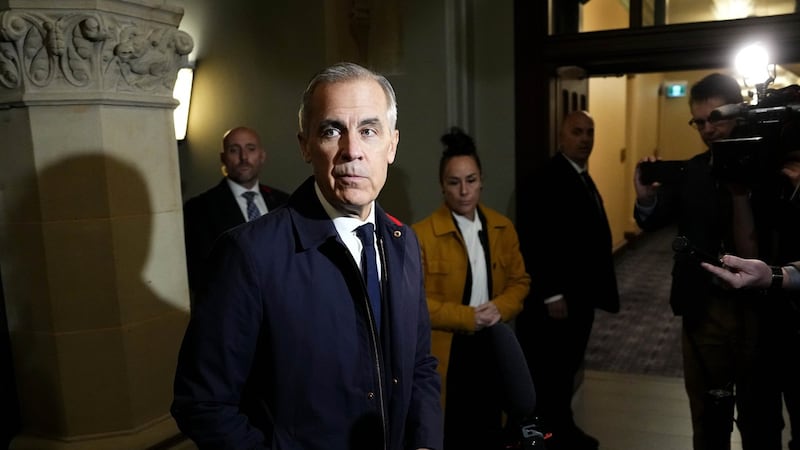
OTTAWA – After days of conflicting messaging surrounding the Gordie Howe International Bridge deal, Prime Minister Mark Carney admits he could have better explained what was agreed upon between Canada and the U.S. “I should have been clearer,” Carney said when asked directly by CTV News if he lied about the agreement at a press conference in Charlottetown on Thursday. “Could I have explained it better on a Sunday morning at Stampede? Yeah. With a cowboy hat on. Yes, I could have explained it better,” the prime minister later added. Carney was referencing his response in an interview with CTV Calgary on July 12 in which he said money from the bridge would only be shared with the U.S. after debt costs were recovered. “We get the revenues. Then the servicing of the costs of the bridge and paying the debt of the bridge, and then what’s left over, there’s a split of that for 15 years,” he said at the time. But official details of the deal published late Tuesday – after days of political pressure – does not explicitly mention interest costs or debt payments related to the bridge. According to the new “proposed agreement in principle” that will run parallel to the original Canada-Michigan Crossing Agreement signed in 2012, Canada will share 50 per cent of net bridge and crossing-related revenues after operational costs with the U.S. for the first fifteen years. “Net bridge and crossing related revenues is all revenues collected with respect to the bridge, less all incurred operating costs of the bridge,” the deal reads. U.S. Commerce Secretary Howard Lutnick appeared to confirm the new revenue sharing agreement in a post to X on July 18, days before the federal government. “Before this deal we got NOTHING. Now, the U.S. gets 50 per cent of net revenues until 2041 and a say in setting the tolls. Our share is before interest and principal,” Lutnick wrote. That change is a notable shift from the original deal, in which Canada agreed to front the $6.4 billion in construction costs and collect 100 per cent of tolls until it recoups its full investment. The agreement estimated that recoupment would take at least 50 years, after which Canada and Michigan would equally split toll revenues. The new parallel deal also indicates that the funds shared with the Americans will go towards the United States-Canada Economic Development Fund that will be controlled by the U.S. In addition, the Americans will need to agree if Canada wants to increase tolls by more than 10 per cent or lower them below compared regional averages during the first 15 years of the bridge’s operations. This part of the agreement could benefit billionaire Matthew Maroun, who owns the nearby Ambassador Bridge and has previously donated to U.S. President Donald Trump. Opposition calls for ‘urgent investigation’ On Thursday, Conservative Alberta MP Kelly McCauley, who chairs the House of Commons committee on government operations and estimates, announced he is convening a meeting on July 29 as opposition members call for “an urgent investigation into the details of the Gordie Howe Bridge deal and the misinformation provided to Canadians about it.” Speaking to reporters in Regina, Conservative House Leader Andrew Scheer accused Carney of misleading Canadians. “We’d like to get an understanding from the government. Did they get anything in return for this concession? We’ve seen Mark Carney offer unilateral concessions before and get nothing for them,” Scheer said on Thursday. Ontario Premier Doug Ford, however, defended Carney. “The prime minister did an excellent job getting this deal done, getting $300 billion of goods across the border to create more opportunities, more jobs,” Ford said Thursday at the closing press conference of the First Ministers’ meeting in Charlottetown. Echoing comments he made to CTV News earlier this month, Carney continued to call the agreement “a good deal” for Canadians and said the revenue sharing will have a “very marginal impact on the overall economics.” “Very marginal because takes time for traffic to ramp up. There’s various costs. There’s various sharing. It gets fed back in, and to put it in order of magnitude, it’s less than five per cent in present value of the overall cost of developing the bridge,” the prime minister explained. He also emphasized that the original agreement signed in 2012 “remains in place.” “There is no splitting of tolls under that agreement, which is what I was referring to, perhaps imperfectly,” he said. Canadian-only celebration set for Friday The bridge has been ready since last month, but its opening has been delayed amid trade tensions. Earlier this year, CTV News reported that both sides were trying to quietly negotiate an opening date after Trump complained in February that Canada was not treating the U.S. fairly on trade. Trump went on a lengthy tirade on social media that included the construction of the bridge as part of his grievance. There was expectation the bridge would open in June after Carney appeared to confirm reporting from U.S. media outlets. But days later, a ribbon-cutting ceremony and the opening was put on hold, with Carney insisting at the time that there was “no big drama.” A Canadian-only celebration, meanwhile, will be held on Friday ahead of next week’s opening. “In light of trade action threatened by the United States earlier this week, it would be inappropriate to proceed with a celebratory event between the two countries,” Jenna Ghassabeh, who is the director of communications for Housing and Infrastructure Minister Gregor Robertson, said in a statement on Tuesday. Earlier this week, Trump threatened to slap a 50 per cent tariff on a variety of Canadian goods on Aug. 19., even if they are compliant under the Canada-U.S.-Mexico Agreement (CUSMA). According to three proclamations signed by Trump on Monday, the U.S. is taking issue with provincial bans on U.S. alcohol, supply management on dairy and certain tariffs and quotas on cars imported to Canada from the United States. Carney said on Thursday that “everything is on the table” when considering retaliation against the United States if there’s no agreement before the new slate of tariffs come into effect next month.