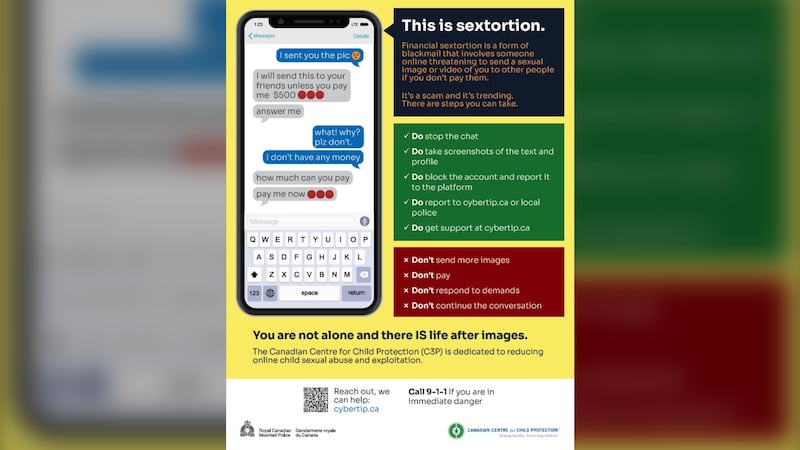
The Saskatchewan Internet Child Exploitation (ICE) unit is advising parents and children to watch out for online “sextortion” scams. In September, the ICE unit received more than 20 reports of sextortion from child victims. The scammer establishes a false identify online, often pretending to be someone close in age to the victim. Scammers usually target youth through chat-based social media platforms like Snapchat. They will then coerce the victim into sending intimate images or videos of themselves. Once the scammer has the images, they extort the victim for money. The scammer threatens to send the images to the victim’s family and friends if no payment is made. Police say the scammers typically target teenage boys. “The way that [scammers are] asking for money is through gift cards,” said Staff Sgt. Tim Failler, provincial coordinator for the Saskatchewan ICE unit. He suspects cases are going unreported. “Young people may be hesitant to report these things because, one they may be embarrassed, two they might think that they’re going to get into trouble if they do report it.” Police advise victims to stop the chat, take screenshots of the threatening messages, and block and report the scam account. Victims are advised not to hand over any money since the scammers will often ask for more after receiving an initial payment. These cases are difficult for police to investigate because scammers are often located overseas. Failler says Cybertip.ca is a good online resource for victims and their families where “they can help with actually removing images. If they are sent online, they can actually help teens get those images back under control.” Alec Couros is a professor of educational technology and media at the University of Regina. He explains that the rise of generative AI makes it easier for scammers to create false identities online, through generated images or even deepfake video calls. Couros says sometimes the scammer isn’t even actually chatting with the victim and is instead using a bot to hold online conversations. He says a scammer “can have 50 of these things going on at once” using either bots or a team of collaborators. AI makes it easier for scammers to create false identities online, through generated images or even deep-fake video calls. Scammers can also use AI and deepfakes to create false images of victims. “The technology is not going to be better, but it’s going to get worse and worse and this is going to be easier and easier,” said Couros. “We’ve got to get to the point where we’re not shaming young people for these things.” Although this specific scam targets teenagers, anyone can be a victim of online extortion.