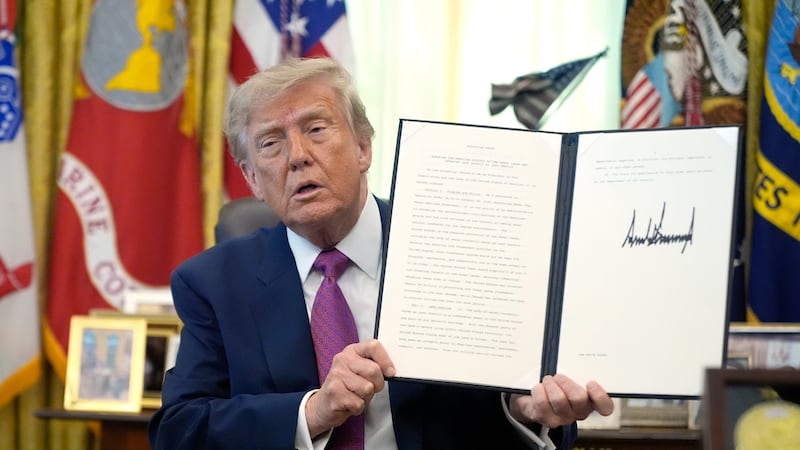
MONTREAL — Canadian astronaut Jeremy Hansen has become the first non-NASA astronaut to receive the American Congressional Space Medal of Honor in a ceremony alongside his crewmates on Friday. U.S. President Donald Trump awarded the four Artemis II astronauts — NASA’s Reid Wiseman, Victor Glover, and Christina Koch, and the Canadian Space Agency’s Hansen — the medal in a ceremony at NASA’s Johnson Space Center. Hansen was the first of his crewmates to receive the medal. Trump highlighted Hansen’s role as the first non-American to travel so far into space before presenting him the medal with a pat on the back and a handshake. “We honour a master of science and physics, a fighter pilot — a great one — and a beloved member of the astronaut team,” Trump said in an introduction that lasted about 40 seconds and was the shortest of the four he delivered. The ceremony comes days after the United States and Canada’s trade negotiations devolved into a renewed trade war, heightening tensions between the two countries. After the crew received their medals, mission commander Reid Wiseman highlighted the work of the many people who made Artemis II possible. “It is not pride for ourselves that we feel, and I truly mean that. It is pride for the grit that our families had when we left this planet. It is pride for this NASA team that sent us on this mission. And it is pride for the international community that stood alongside us, got this vehicle ready, operated it, and cheered us on,” he said. Hansen echoed Wiseman’s sentiment in an emailed statement to The Canadian Press. “Artemis II showed what we can accomplish for humanity when we set ambitious goals and work together. For Canada, the mission and the Artemis program as a whole are about much more than just going back to the Moon. It is about the pursuit of excellence and collaboration,” he wrote. The medal is awarded to astronauts who have distinguished themselves and contributed to the well-being of the world. In total, 34 astronauts have received it, including 17 who received it after their death on a mission. “This is a very rare thing. It’s for courageous people, for brilliant people,” said Trump in his opening remarks. Hansen became the first non-American to travel beyond low Earth orbit and to venture to the moon while flying in the historic Artemis II mission in April. Three months after Hansen and his three American crewmates returned from their lunar flyby, he announced he was retiring from Canada’s astronaut program. On Aug. 21, at the Canadian National Exhibition in Toronto, he said he wanted to spend his time post-retirement finding ways to keep pushing the country’s space industry forward. During Friday’s ceremony, Trump announced the creation of a U.S. space academy to support American space exploration. The ceremony was also an opportunity for NASA and government officials to advertise the rest of the Artemis program and promote the possibility of future American presence on the Moon and on Mars. Speakers credited Trump for the renewal of energy for space exploration. “President Trump ignited the golden age of exploration and discovery,” said Matt Anderson, NASA’s deputy administrator. Trump repeated his hopes to see American astronauts plant the country’s flag on Mars in the near future. “Our manifest destiny is to explore and settle this great unknown,” he said. On June 9, NASA revealed the crew for its Artemis III mission: the American agency’s Randy Bresnik, Frank Rubio, Andre Douglas and the European Space Agency’s Luca Parmitano. In the mission, planned for 2027, the crew will remain in Earth orbit and practice docking their Orion capsule with two lunar landers. This report by The Canadian Press was first published Aug. 28, 2026. Marieke Glorieux-Stryckman, The Canadian Press