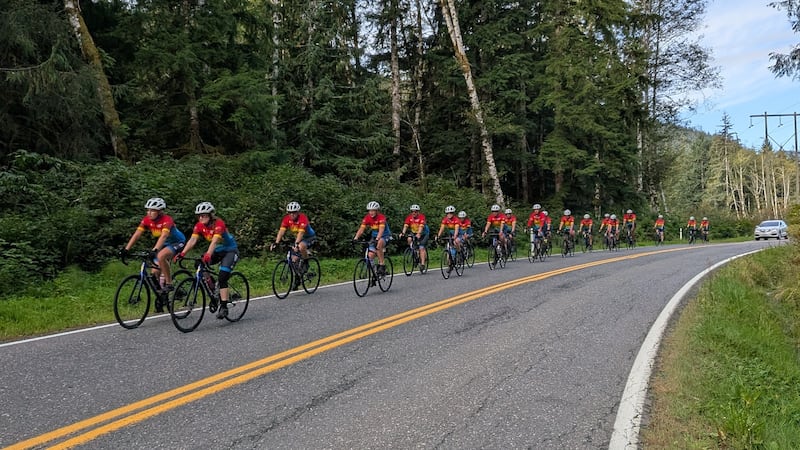
Twenty-two police officers and emergency services personnel are swapping patrol cars and emergency vehicles for road bikes, taking on a 1,200-kilometre journey across Vancouver Island to raise money for children and families affected by cancer. The Cops for Cancer Tour de Rock riders will spend 14 days on the road, travelling through communities, meeting families and visiting schools and businesses along the way. For RCMP Cpl. Alex Bérubé, the reason for joining the ride is personal. Several members of his family have been affected by cancer and survived. Bérubé, a B.C. RCMP media relations officer on Vancouver Island, has also spent years watching Tour de Rock riders make their way across the Island through his work as a police officer. This year, he decided it was time to join them. “I really want to be part of something as big as this,” Bérubé said. “And this year, the 29th edition of the Tour de Rock was the perfect time for me to do it. And I’m very happy that I stepped up.” The riders are already seeing how deeply the fundraiser resonates in the communities they visit. In Port Alice, a community fundraiser brought in more than $26,000. “It was so amazing,” Bérubé said. “It was my first time in the North Island. And to see how tight knit the community is over there is truly heartwarming.” Bérubé said the amount raised was believed to be a record for the North Island. Tour de Rock raises money for childhood cancer research as well as programs that support children and families living with the disease. One of those programs is Camp Goodtimes, a medically supervised camp where families affected by cancer can connect with others who understand what they are going through. Nichole Doucette’s family attended the camp after her son Ty was diagnosed with leukemia. “Camp Goodtimes is a very special place on earth,” Doucette said in a statement. “While we don’t want to be part of the cancer club, we’re happy that Camp Goodtimes is there, because we are part of that club,” she said. According to the Canadian Cancer Society, nearly 1,000 children in Canada are diagnosed with cancer each year. While survival rates have improved, the impact of treatment can continue long after a child has finished treatment. The society says two thirds of children diagnosed with cancer will experience long term or late side effects. For Bérubé, meeting families affected by childhood cancer has made the purpose of the ride even more tangible. “You truly don’t know what to expect until you live it,” he said. “When you hear the stories of the children and the families involved, you can’t help but feel the emotions. I don’t think there’s one person in a room that had a dry eye.” The emotional moments are unfolding alongside some serious physical demands. The riders have already travelled from Port Alice through Port Hardy and Port McNeill, with some of their longest days still ahead. One stretch is expected to cover between 140 and 160 kilometres. Bérubé said the team is excited to take it on, even with rain potentially in the forecast. But the physical challenge is not what brings the riders back to the road each morning. “It’s very important for us to be part of this and support those families and those children battling cancer,” Bérubé said. The Canadian Cancer Society says it has invested more than $11 million in childhood cancer research over the past five years, while also providing information and support to children and families affected by the disease. As the riders continue south, they will carry the stories they have heard with them. “I couldn’t think of a better cause than this,” Bérubé said. People can support the riders and learn more about the fundraiser through Cops for Cancer.