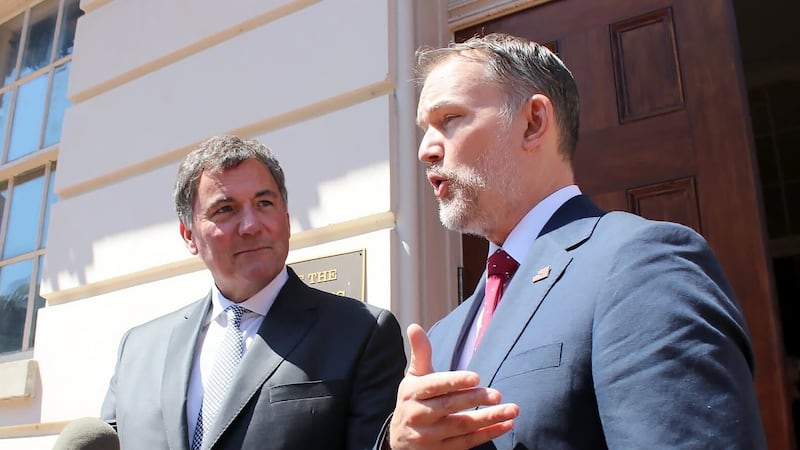
Canada-U.S. Trade Minister Dominic LeBlanc is heading back to Washington today for more talks after U.S. President Donald Trump chose to delay his new tariffs until later this week. A statement from LeBlanc’s office says the minister and Chief Negotiator Janice Charette will meet with U.S. Trade Representative Jamieson Greer at 12:15 p.m. ET at the United States Trade Representative’s offices. Canada and the U.S. now have until Saturday to reach a deal before Trump imposes 50 per cent tariffs on Canadian goods. In a Truth Social post Tuesday night, the U.S. president stated that he would delay his tariffs for three days and added that the two countries have reached a tentative deal. He also said that the Keystone XL pipeline “may be awoken from the grave.” Prime Minister Mark Carney’s own statement released Wednesday did not mention a deal or a pipeline, but said that “substantial progress has been made.” Follow along for key updates: ‘Sounds like Canada has given up’: Scheer Conservative House leader Andrew Scheer says although he’s “cautiously optimistic,” he is “worried” about what Carney may be giving to avoid 50 per cent tariffs. “My hope is that we get an elimination of tariffs. It sounds like Canada has given up,” Scheer told CTV Your Morning Saskatchewan Thursday morning. Scheer said the big question is whether Carney comes back with zero tariffs, or the baseline of 25 per cent. “If he comes back with a deal where there’s still 25 per cent tariffs on steel and aluminum, there’s going to be a lot of workers here in Regina (and) across the country that will be scratching their heads, saying, ‘You know, Mark Carney seems to have given up quite a lot.’” Scheer also echoed criticism raised by Conservative Leader Pierre Poilievre, saying Carney has failed to brief the Opposition on negotiations. “We’re in a little bit of a wait-and-see mode. We’ll see what the final deal is.” Kayla Thompson, CTVNews.ca journalist Softwood lumber is ‘outlier’ in trade talks: expert It’s still unclear how softwood lumber will be treated in ongoing trade negotiations, according to an industry expert. But Derek Nighbor, president and CEO of Forest Products Association of Canada says that he’s “optimistic.” The industry employs almost 200,000 people in Canada, “more than auto, steel and aluminum combined,” he told CTV News Channel on Thursday. “We’re still hopeful in the home stretch here,” he added. Ideally, Sections 338 and 232 which directly impact the industry would be eliminated, he said. “If we can see those tariffs go away and if we can get a commitment to see Canada and the United States get back to the table to negotiate an agreement on softwood, I think that would be a pretty good outcome,” he said. Under existing tariffs, the industry is losing market share to the Americans, Austrians, Swedes and Germans, as the Europeans only bear a 15 per cent premium, he said. “We’ve heard the president talk this week a lot about fairness and treating Canada more equally in different segments like other countries,” he said. “Lumber is clearly an outlier, and we’d like to see that gap close very much.” Devika Desai, CTVNews.ca journalist Foreign affairs minister travels to Washington Anita Anand, Canada’s minister of foreign affairs, will travel to Washington on Thursday to meet her U.S. counterpart, Secretary of State Marco Rubio. Global Affairs Canada stated in a press release on Thursday that the two will discuss “continental security and other global priorities” but did not share more details. According to a Thursday schedule released by the U.S. Department of State, Anand will meet with Rubio at 1:30 p.m. EDT at the White House. The meeting will be closed to the media. Anand’s office has confirmed the meeting is not related to trade negotiations. Devika Desai, CTVNews.ca journalist Premiers are optimistic Some premiers say they’re optimistic about Canada’s progress in reaching a trade deal to avoid punishing tariffs from the United States, while others say they’re waiting for more details about the agreement. Nova Scotia Premier Tim Houston told reporters Wednesday that he was “optimistic” about the deal, adding that Prime Minister Mark Carney has asked provinces to restock American alcohol on their shelves. B.C.’s David Eby said that while no agreement will offer everything the country is hoping for, the federal government has made substantial progress across strategic sectors. Scott Moe of Saskatchewan said Wednesday that he hopes both countries can negotiate a deal that would reduce U.S. tariffs on Canadian steel, aluminum, autos and lumber. Quebec Premier Christine Fréchette told reporters it was too soon to make a judgment call about the deal, adding that she needed more information to see whether it’s positive for her province. The Canadian Press Province needs to diversify: N.S. premier Nova Scotia Premier Tim Houston said that Canada’s trade dispute with the U.S. has been a wake-up call to diversify the province’s economy. Houston was responding late Wednesday to a potential Canada-U.S. trade deal from Banff, Alta., where he’s promoting energy projects at an industry conference. He said the dispute has taught the province it needs to develop more diverse trading partners for sectors like seafood and agriculture, though the U.S. market is still important. He said Nova Scotia also has to be more self-sufficient, especially on the energy file. “The whole experience has taught us something really important about diversification and pushing Nova Scotian opportunities,” Houston told reporters. " “That’s why I’m in Alberta right now talking about Nova Scotia gas and ... oil and ... opportunities. Diversifying our trading partners for our markets and seafood and agriculture and all kinds of things.” The Canadian Press, Read the full article here Reducing steel, aluminum tariffs ‘extremely important’: expert An international trade lawyer says an agreement that includes reductions to Section 232 tariffs on steel and aluminum will be “extremely important” for sectors that have been “really suffering.” “If we can regain access to the United States market, our producers are going to be in a much better place, and might even have a competitive advantage compared with the rest of the world,” William Pellerin told CTV News Channel on Thursday. While neither side has confirmed details involving dairy, comments made by Trump on Wednesday that the new agreement is “great for our farmers” leads Pellerin to suspect “minor concessions” have been made. Left off the negotiating table so far is softwood lumber, which Pellerin said is a disadvantage for Quebec, British Columbia and Alberta lumber producers. “It would have been nice relief, but I think we probably didn’t have enough cards to play to also get some relief on that sector,” he said. Kayla Thompson, CTVNews.ca journalist Keystone XL benefits both: expert “It’s really one of those unique cases where I think both countries benefit,” said Dennis McConaghy, a former Canadian energy executive, on Thursday. In an interview with CTV Your Morning, McConaghy explained that Canada would benefit economically if Keystone XL were revived, since Canadian heavy oil suits U.S. refineries. “Now the argument has always been Canada might gain more economic margin by sending its incremental oil production to the West Coast,” McConaghy said. “Of course, that means you have to be able to get a pipeline built to the West Coast, and that’s always had obvious risks.” Devika Desai, CTVNews.ca journalist Avoid ‘escalation’: agri-food expert Canada’s agri-food exporters are “optimistic” about Trump’s tariff pause as it abated a potential “escalatory spiral” that could have hurt business, a Canadian expert says. Michael Harvey, the executive director of the Canadian Agri-Food Trade Alliance, told CTV News Channel on Wednesday that while the industry isn’t directly impacted by the tariffs, there has been “an increasing level of political risk that’s made it difficult to make business decisions to invest.” “Our concern has been an escalatory spiral where there could be across-the-board tariffs that would hit,” he said. Despite becoming a more difficult market to work with, the U.S. still makes up 70 per cent of Canada’s agri-food exports, he added. “We have to manage these contradictory ... situations.” “Our situation is of confidence, but not too much confidence.” Devika Desai, CTVNews.ca journalist PM Carney asks for return of U.S. booze Following a virtual first ministers meeting, Nova Scotia Premier Tim Houston said Prime Minister Mark Carney asked the provincial leaders “to return the U.S. alcohol to the shelf.” In a virtual media conference on Wednesday, Houston said the ask is “something that came directly out of the negotiating table,” and is “something that (he) would be willing to do for the prime minister at this point in time.” “Whether Nova Scotians or whether Canadians will actually buy it when it gets back on the shelves, that’s a whole other discussion,” he added. Kayla Thompson, CTVNews.ca journalist Provincial sources: trade deal not done Multiple provincial sources are sharing cautious optimism with CTV News following a briefing with Carney on the tentative trade deal between Canada and the U.S. However, they also emphasized that the deal is not done yet. In a post to Truth Social late Tuesday, Trump said the countries “have a deal,” but sources say that characterization is not accurate and further negotiations are ongoing. The provincial sources also tell CTV News that Carney personally asked the premiers to return U.S. alcohol to store shelves. He even told them he will bear any public pushback if that happens. According to a recent Nanos Research survey, most Canadians say they won’t purchase U.S. booze if it returns to stores. Stephanie Ha, bureau manager, Ottawa News Bureau With files from CTV News’ chief political correspondent Vassy Kapelos