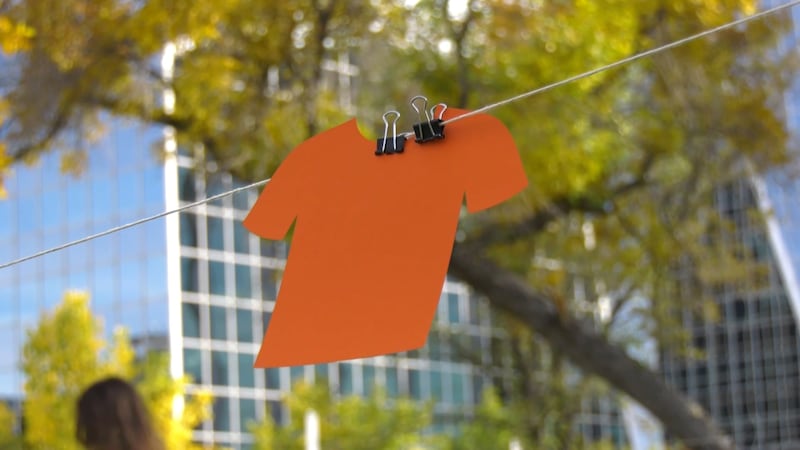
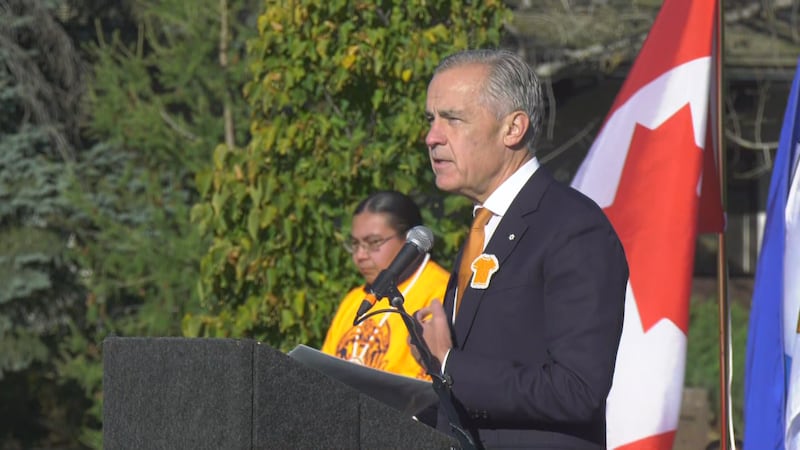
Prime Minister Mark Carney says the work of reconciliation is never over as Canada reflects on Indigenous communities whose children survived government-sanctioned residential schools and those who never made it home. His visit to his hometown of Edmonton fell on the National Day for Truth and Reconciliation, where he addressed the crowd at a ceremony featuring drumming, traditional dancers and orange shirts at Fort Edmonton Park. Carney acknowledged the dignitaries gathered, among them being Federal Conservative Leader Pierre Poilievre, but focused his attention on the children. It’s Canada’s sixth year officially marking the statutory holiday. Carney says the federal government especially remains responsible for “building in true partnerships with Indigenous people.” “Today is about all the truth,” he said. “It’s for the children. Those survivors. Those who didn’t survive. “Today’s ceremony calls on us to hear your stories and to reflect on a dark chapter in Canada’s past and to commit to move forward together.” Between 1857 and 1996, more than 150,000 First Nations, Inuit and Metis Nation children in Canada were taken from their families and communities and sent to church-run residential schools, where abuse and malnutrition were rampant. Many children never returned home. Cree Elder Marilyn Buffalo was a survivor. “Orange shirt day is not a day I look forward to … We were punished for speaking our language,” she told the crowd on Wednesday. “Many of us defied the authorities and stuck to the guns of our great-grandmothers, and have continued on to do the work and advocacy. “I asked all of you, in all your positions …. Please support our children, because they need healing. They need guidance.” In 2015, the Truth and Reconciliation Commission concluded the schools were an integral part of a state-backed policy of cultural genocide. They later issued a call to action for the federal government to acknowledge this. The National Day for Truth and Reconciliation, which is commemorated in conjunction with Orange Shirt Day, was made a federally observed event in 2021. “The work of reconciliation is far from finished. The wounds are still too deep, the gaps are still too wide,” Carney remarked. “Reconciliation is a journey, not a destination. It’s an attitude, not an achievement.” Andrea Sandmaier, president of the Otipemisiwak Métis Government, says the work is every day for Indigenous people. The nation-building point Carney spoke to, she added, was a “big piece of reconciliation.” “We need to make sure that we’re at the table, that we are respected, that we are true partners. That means talking to us before they’re making decisions,” she told reporters. Sandmaier says she’ll primarily spend Wednesday thinking about the children. “We need to honour them. We need to remember them. That’s why today is so important.” Canadians can help residential school survivors and their families by donating to Indigenous-led organizations. The National Residential School Crisis Line is a toll-free, 24-hour support and crisis referral service for former residential school students and their families. With files from CTV News Edmonton’s Curtis Goodrum