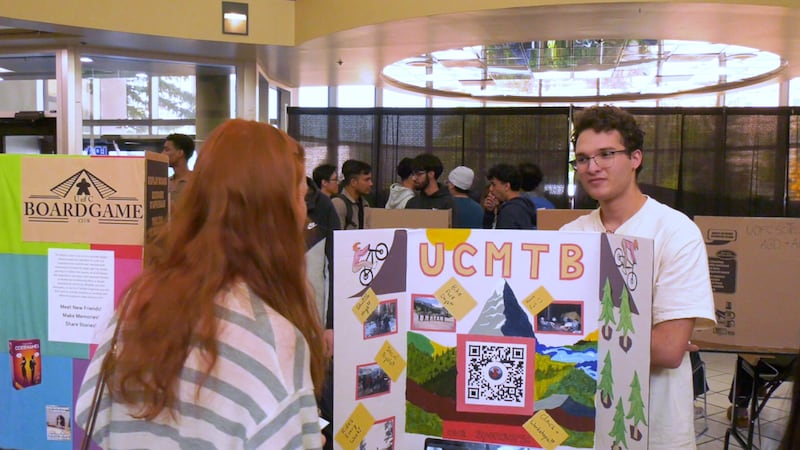
For Alberta university students preparing to enter the workforce, buy homes and build careers, the province’s debate over its place in Canada is raising questions about what their own futures could look like. “I’ve lived in Alberta my whole life. I really love Calgary and all my family is here,” said Solomon Spivak, a second-year mechanical engineering student at the University of Calgary. But Spivak said he believes separating would be “a massive mistake.” Spivak was among hundreds of students filling the University of Calgary’s MacEwan Student Centre for Club Week, where booths promoting student groups lined the halls and students crowded around tables looking for ways to get involved on campus. Amid the bustle, CTV News spoke with multiple students about Alberta’s future in Canada and five agreed to share their opinions. All said they opposed separation, though their reasons varied from concerns about jobs and economic uncertainty to identity and what independence could mean for their futures. “If we’re cut off from the rest of the country, I don’t know what that means for me, going into a job,” said Gabriela Lubon, a biological sciences student with a minor in English. But separation isn’t necessarily the issue dominating everyday conversations among students. “I don’t know that I’ve heard anybody speak of the referendum or the independence separation at all. But people are talking about how expensive it is to live and how expensive it is to just be a student,” Lubon said. Affordability, housing and the cost of living were among the concerns students repeatedly raised when asked what worries them most about their futures. “The housing market is expensive. Groceries are expensive. I’m afraid I won’t be able to live where I want to when I’m older,” Spivak said. “Housing is a big concern. I’m anxious a bit about the cost of living,” said Isaac Emblin, a chemical engineering student. The long-term effects Those questions about jobs, wages and affordability were among the issues examined in a recent University of Calgary School of Public Policy report forecasting the potential economic and fiscal implications of Alberta separating from Canada. The report estimates establishing an independent Alberta could cost between $50 billion and $170 billion over the first five years, depending in part on how negotiations with Canada unfold. While the report examines the potential impact on Albertans broadly, Garrett Kent Fellows, an associate professor of economics at the School of Public Policy and one of its researchers, spoke to CTV News about what the findings could mean for younger Albertans planning their careers and financial futures. “If you look out sort of five to 10 years, what we actually see is a depressed economy overall,” Fellows said. “There are a couple of reasons for this, but a big one is investment uncertainty.” Fellows said investors generally look for stable institutions, long-term prospects for growth and predictable governance. Separation, he said, would raise questions about what those institutions would look like in an independent Alberta. “That means there’s less investment. That means there are fewer jobs, and incomes might be lower in the short run,” he said. Longer-term outcomes would depend in part on the trading relationships an independent Alberta established with Canada and the United States. But he says there could also be economic benefits in some scenarios. “On the upside, there may be benefits for oilsands, in particular in the resource industries,” Fellows said. Under a more amicable separation scenario, the report found Alberta could eventually see higher GDP, lower taxes and higher wages. The modelling estimated annual wages could be about $1,851 higher, though those gains would take roughly two decades to materialize. But the outcomes varied significantly depending on how separation unfolded. “On most of the scenarios we model, the economy ends up actually weaker, not stronger,” Fellows said. A ‘double whammy’ For students already worried about affordability, the modelling also examined what could happen to both wages and prices. “Even if your paycheck doesn’t change that much, you still end up losing purchasing power,” Fellows said. “And in fact, in our modelling, it happens on both sides. The paychecks get smaller and the costs get higher. So, it’s kind of that double whammy.” The stakes are one reason Rodge Reyes, a third-year sociology and psychology student, believes his generation needs to pay attention. “We are the future bearers for this nation,” Reyes said. “I definitely think that it’s important for us, like young people, to know what’s going on.” But some students said understanding the debate can itself be a challenge. Casandra David, a third-year community rehabilitation and psychology student, said complicated language can make issues difficult to navigate. “There’s information that makes it kind of inaccessible for us to fully understand what’s going on sometimes,” she said. “Especially with jargon and complicated language, some people are like, ‘What even is that?’” David said determining what information online is trustworthy has become another challenge. “With the rise of AI and everything, sometimes you don’t even know what is true and false on the internet,” she said. Spivak said he worries some of his peers aren’t sufficiently engaged with the issue. “I find my peers are uninformed and are easily swayed in this type of thing,” he said. Fellows said young voters should consider the economic possibilities of both paths as they make up their minds. “Take a look at the economic outcomes that the country is headed for right now,” he said. “And if you’re thinking specifically about how you’re going to vote in the referendum, really put some thought into what an independent Alberta would look like and what a future inside of Confederation looks like.” Lubon said some students may believe separation is unlikely, but she doesn’t see that as a reason to disengage. “I think that people don’t believe this will go through,” she said. “But as we’ve seen in past cases, when people don’t take action, action gets taken for them.” For Spivak, the debate has already prompted him to consider whether the province where he has spent his entire life would remain the place where he builds his future. “I will not stay if Alberta leaves,” he said. “I’m moving to B.C.”